Monday, October 17, 2022

"My Good Man"

New from Levine Querido: My Good Man by Eric Gansworth.

About the book, from the publisher:

It's a rare book that can make the tried-and-true genre of the coming-of-age novel seem novel. There are the standard markers of the hero's journey - the trials, the dark night of the soul, the lesson learned. From Printz honor author Eric Gansworth comes My Good Man, a literary tour-de-force sure to turn the genre on its head.

Brian, a 20-something reporter on the Niagara Cascade's City Desk, is navigating life as the only Indigenous writer in the newsroom, being lumped into reporting on stereotypical stories that homogenize his community, the nearby Tuscarora reservation. But when a mysterious roadside assault lands Tim, the brother of Brian's mother's late boyfriend in the hospital, Brian must pick up the threads of a life that he's abandoned.

The resulting narrative takes us through Brian's childhood and slice of life stories on the reservation, in Gansworth's signature blend of crystal sharp, heartfelt literary realist prose.

But perhaps more importantly, it takes us through Brian's attempt to balance himself between Haudenosaunee and American life, between the version of his story that would prize the individual over all else and the version of himself that depends on the entire community's survival.
Learn more about the book and author at Eric Gansworth's website.

My Book, The Movie: If I Ever Get Out of Here.

Writers Read: Eric Gansworth (September 2013).

The Page 69 Test: If I Ever Get Out of Here.

--Marshal Zeringue

"The Island of Extraordinary Captives"

New from Scribner: The Island of Extraordinary Captives: A Painter, a Poet, an Heiress, and a Spy in a World War II British Internment Camp by Simon Parkin.

About the book, from the publisher:

The remarkable untold story of a Jewish orphan who fled Nazi Germany for London, only to be arrested there by the British government and sent to an internment camp for suspected foreign agents on the Isle of Man, alongside a renowned group of refugee musicians, intellectuals, artists, and—possibly—genuine spies.

Following the events of Kristallnacht in 1938, Peter Fleischmann evaded the Gestapo’s midnight roundups in Berlin by way of a perilous journey to England via the Kindertransport train. But he could not escape the British police, who came for him in the early hours and shipped him off to Hutchinson Camp on the Isle of Man, under suspicion of being a spy for the very regime he had fled.

Peter’s story was no isolated incident. During Hitler’s rise to power in the 1930s, tens of thousands of German and Austrian Jews escaped and found refuge in Britain. Once war broke out in 1939, the nation turned against them, fearing that Nazis had planted spies posing as refugees. Innocent asylum seekers thus were labeled “enemy aliens” and ultimately sentenced to an indefinite period of internment.

When Peter arrived at Hutchinson Camp, he found one of history’s most astounding prison populations: renowned professors, composers, journalists, and artists. Together, they created a thriving cultural community, complete with art exhibitions, lectures, musical performances, and poetry readings. The artists welcomed Peter as their pupil and forever changed the course of his life. Meanwhile, suspicions grew that a real spy was hiding among them—one connected to a vivacious heiress from Peter’s past.

Drawing from unpublished first-person accounts and newly declassified documents from the British government, award-winning journalist Simon Parkin tells the story of this unlikely group of internees. The Island of Extraordinary Captives brings history to life in vivid detail, revealing the hidden truth of Britain’s grave wartime mistake and showcasing how hope and creativity can flourish in even the darkest of circumstances.
Visit Simon Parkin's website.

--Marshal Zeringue

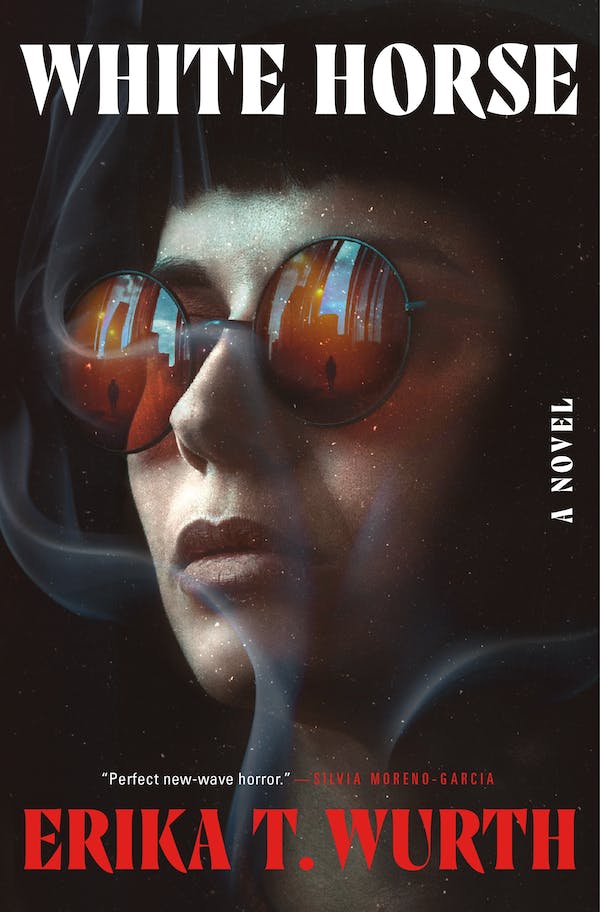
"White Horse"

New from Flatiron Books: White Horse: A Novel by Erika T. Wurth.

About the book, from the publisher:

Some people are haunted in more ways than one…

Kari James, Urban Native, is a fan of heavy metal, ripped jeans, Stephen King novels, and dive bars. She spends most of her time at her favorite spot in Denver, a bar called White Horse. There, she tries her best to ignore her past and the questions surrounding her mother who abandoned her when she was just two years old.

But soon after her cousin Debby brings her a traditional bracelet that once belonged to Kari’s mother, Kari starts seeing disturbing visions of her mother and a mysterious creature. When the visions refuse to go away, Kari must uncover what really happened to her mother all those years ago. Her father, permanently disabled from a car crash, can’t help her. Her Auntie Squeaker seems to know something but isn’t eager to give it all up at once. Debby’s anxious to help, but her controlling husband keeps getting in the way.

Kari’s journey toward a truth long denied by both her family and law enforcement forces her to confront her dysfunctional relationships, thoughts about a friend she lost in childhood, and her desire for the one thing she’s always wanted but could never have…
Visit Erika T. Wurth's website.

--Marshal Zeringue

"Making Our Future"

Coming November 22 from The University of North Carolina Press: Making Our Future: Visionary Folklore and Everyday Culture in Appalachia by Emily Hilliard.

About the book, from the publisher:

In this book, Emily Hilliard draws from her work as state folklorist to explore contemporary folklife in West Virginia. In doing so, she challenges the common perception of both folklore and Appalachian culture as static, antiquated forms, offering instead the concept of visionary folklore as a future-focused, materialist, and collaborative approach to cultural work.

With chapters on the expressive culture of the West Virginia teachers' strike, the cultural significance of the West Virginia hot dog, the tradition of independent pro wrestling in Appalachia, the practice of nonprofessional women songwriters, the collective counternarrative of a multiracial coal camp community, the invisible landscape of writer Breece D'J Pancake's hometown, the foodways of an Appalachian Swiss community, the postapocalyptic vision presented in the video game Fallout 76, and more, the book centers the collective nature of folklife and examines the role of the public folklorist in collaborative engagements with communities and culture. Hilliard argues that folklore is a unifying concept that puts diverse cultural forms in conversation, as well as a framework that helps us reckon with the past, understand the present, and collectively shape the future.
Visit Emily Hilliard's website.

--Marshal Zeringue

Sunday, October 16, 2022

"The Break"

New from Little A: The Break: A Novel by Katie Sise.

About the book, from the publisher:

Can she trust the people she loves? Can she trust herself? A new mother is pushed to the edge in a provocative thriller by the Amazon Charts bestselling author of Open House.

After the traumatic birth of her daughter at a New York City hospital, Rowan O’Sullivan returns home to her apartment with her perfect newborn, Lila. At her side are her husband, Gabe, and June, a part-time babysitter hired to help Rowan in any way she can.

But in this time of joy, Rowan can’t shake the feeling that something isn’t right. She feels dread. She’s breaking.

Rowan’s growing instability leads her to accuse June of unspeakable things. And when June disappears just days later, Rowan becomes a suspect. The neighbors heard the screaming. But only Rowan knows what really happened. If her mind can be trusted. Since Lila’s birth, her memory has been both unreliable and frightening.

To uncover what happened to June and protect her new baby, Rowan must try to untangle the deep recesses of her mind and face the dark things she’s so desperate to keep buried. When she does, no one is prepared for where the truth leads.
Visit Katie Sise's website.

Writers Read: Katie Sise (September 2018).

--Marshal Zeringue

"Astaire by Numbers"

Coming soon from Oxford University Press: Astaire by Numbers: Time & the Straight White Male Dancer by Todd Decker.

About the book, from the publisher:

Astaire by Numbers looks at every second of dancing Fred Astaire committed to film in the studio era--all six hours, thirty-four minutes, and fifty seconds. Using a quantitative digital humanities approach, as well as previously untapped production records, author Todd Decker takes the reader onto the set and into the rehearsal halls and editing rooms where Astaire created his seemingly perfect film dances. Watching closely in this way reveals how Astaire used the technically sophisticated resources of the Hollywood film making machine to craft a singular career in mass entertainment as a straight white man who danced.

Decker dissects Astaire's work at the level of the shot, the cut, and the dance step to reveal the aesthetic and practical choices that yielded Astaire's dancing figure on screen. He offers new insights into how Astaire secured his masculinity and his heterosexuality, along with a new understanding of Astaire's whiteness, which emerges in both the sheer extent of his work and the larger implications of his famous "full figure" framing of his dancing body.

Astaire by Numbers rethinks this towering straight white male figure from the ground up by digging deeply into questions of race, gender, and sexuality, ultimately offering a complete re-assessment of a twentieth-century icon of American popular culture.
--Marshal Zeringue

Saturday, October 15, 2022

"My Dirty California"

New from Simon & Schuster: My Dirty California by Jason Mosberg.

About the book, from the publisher:

In this literary thriller, a young man descends into the Los Angeles underworld to find his family’s killer—aided by a group of strangers with their own shadowy pasts.

When Marty returns to Pennsylvania after living in California for ten years, he’s happily welcomed by his father and older brother, Jody. The joyful reunion is short-lived. Two days later, Jody enters the house to find his father and Marty shot dead as their masked killer flees out the back door. Without any answers from the local police, Jody heads to Los Angeles looking for who murdered his family and why.

Soon, he finds a trove of strange videos recorded by his brother that leads him into the city’s most dangerous corners, where he comes up against drug dealers, crooked cops, surf gangs, and black-market profiteers. As his investigation expands, it also intersects with Pen, a documentary filmmaker who suspects humanity is living in a simulation and that her missing father found a portal to escape; Renata, an undocumented immigrant who might have evidence to support Pen’s theory; and Tiph, a young mother whose desperate efforts to support her only child via a stolen art stash could prove the key to answering all these mysteries.

My Dirty California is a cinematic, suspenseful, intricately plotted thriller that explores the darker side of the glamorous Golden State.
Visit Jason Mosberg's website.

--Marshal Zeringue

"Black France, White Europe"

New from Cornell University Press: Black France, White Europe: Youth, Race, and Belonging in the Postwar Era by Emily Marker.

About the book, from the publisher:

Black France, White Europe illuminates the deeply entangled history of European integration and African decolonization. Emily Marker maps the horizons of belonging in postwar France as leaders contemplated the inclusion of France's old African empire in the new Europe-in-the-making. European integration intensified longstanding structural contradictions of French colonial rule in Africa: Would Black Africans and Black African Muslims be French? If so, would they then also be European? What would that mean for republican France and united Europe more broadly?

Marker examines these questions through the lens of youth, amid a surprising array of youth and education initiatives to stimulate imperial renewal and European integration from the ground up. She explores how education reforms and programs promoting solidarity between French and African youth collided with transnational efforts to make young people in Western Europe feel more European. She connects a particular postwar vision for European unity―which coded Europe as both white and raceless, Christian and secular―to crucial decisions about what should be taught in African classrooms and how many scholarships to provide young Africans to study and train in France. That vision of Europe also informed French responses to African student activism for racial and religious equality, which ultimately turned many young francophone Africans away from France irrevocably. Black France, White Europe shows that the interconnected history of colonial and European youth initiatives is key to explaining why, despite efforts to strengthen ties with its African colonies in the 1940s and 1950s, France became more European during those years.
--Marshal Zeringue

Friday, October 14, 2022

"The Hunger Between Us"

Coming November 1 from Farrar, Straus and Giroux (BYR): The Hunger Between Us by Marina Scott.

About the book, from the publisher:

For fans of Elizabeth Wein and Ruta Sepetys, an absorbing, fast-paced YA debut novel from Marina Scott about a girl’s determination to survive during the Nazi siege of Leningrad—and to save her best friend from a horrible fate.

There are some lines that should never be crossed—even in a city ruled by hunger.
The black market is Liza’s lifeline, where she barters family heirlooms and steals whatever she can get her hands on just for enough food to survive. Morality, after all, has become a fluid thing since the Nazi siege has cut off her city from the rest of the world. Hope for a quick liberation is obliterated as the Soviet government focuses on sustaining the Red Army and not the city, subjecting its people to unimaginable cruelties at the hands of the secret police. When Liza’s best friend Aka proposes that they go to the same bullying officials, rumored to give young women food in exchange for “entertainment,” Liza thinks there surely must be some other way. Then Aka disappears and Liza resolves to rescue her no matter the cost, entangling herself in an increasingly dangerous web with two former classmates, one a policeman, the other forced to live underground.

The Hunger Between Us is an absorbing novel about being trapped with impossible choices and the bonds of love that are tested along dangerous paths.
Follow Marina Scott on Twitter.

--Marshal Zeringue

"Demagogues in American Politics"

New from Oxford University Press: Demagogues in American Politics by Charles U. Zug.

About the book, from the publisher:

While demagoguery is traditionally regarded as destabilizing and dangerous, this book shows how it can also be used to advance the common good.

Most of us think that demagoguery is, by definition, bad. Relatedly, scholars almost invariably treat demagoguery as a divisive practice that appeals to what is worst in an audience at the expense of what is best for the public good. In Demagogues in American Politics, Charles U. Zug offers a historical analysis of the role of demagoguery in the American political system. Challenging the conventional wisdom, he argues that demagoguery is not an inherently bad form of leadership. Whereas classical thinkers had believed that demagoguery was always a threat to political order, the most sophisticated founders of the American Constitution-inspired by Enlightenment political philosophy-recognized that demagoguery, though dangerous, could be recruited by the Constitution to improve the political system. Through case studies drawn from the presidency, Congress, and the Supreme Court, this book argues that demagogic leadership can be deployed by public officials to advance the aspirations of constitutional democracy.
Visit Charles U. Zug's website.

--Marshal Zeringue