Sunday, February 23, 2025

"Unstable Ground"

New from Columbia University Press: Unstable Ground: The Lives, Deaths, and Afterlives of Gold in South Africa by Rosalind C. Morris.

About the book, from the publisher:

What has gold done to people? What has it made them do? The Witwatersrand in South Africa, once home to the world’s richest goldfields, is today scattered with abandoned mines into which informal miners known as zama zamas venture in an illicit―often deadly―search for ore. Based on field research conducted across more than twenty-five years around these mines, Unstable Ground reveals the worlds that gold made possible―and gold’s profound costs for those who have lived in its shadow and dreamt of its transformative power.

From the vantage point of the closure of South Africa’s gold mines, Rosalind C. Morris reconsiders their histories, beginning in the present and descending into the pasts that shaped them. Anchored in evocative descriptions of mining in the ruins, this book explores the social worlds built on gold and the lives that were remade and sometimes undone by the industry over a century and a half. Viewing this industry from its margins, against the backdrop of the cyanide revolution, the gold standard’s demise, and recurrent sinkholes, as well as the insurrectionary protests and violence that continue to this day, it recasts the history of South Africa and the incomplete effort to overcome apartheid amid the transformations of the global economy. In writing that is by turns immersive, incisive, and poetic, Morris unearths a history that was born of imperial aspiration and that persists as a speculative mirage. Interweaving ethnography, history, personal testimony, and political thought with striking readings of South African literary texts, Unstable Ground is a work of extraordinary ambition and depth.
Visit Rosalind C. Morris's website.

--Marshal Zeringue

"The Warbler"

New from Lake Union: The Warbler: A Novel by Sarah Beth Durst.

About the book, from the publisher:

From the New York Times bestselling author of The Lies Among Us comes a magical tale about mothers and daughters, choices and consequences, and the real meaning of home when every place feels like a cage.

Ten months. That’s the longest Elisa has stayed anyplace, constantly propelled by her fear that if she puts down roots, a family curse will turn her into a tree.

But she’s grown tired of flitting from town to town and in and out of relationships. When she discovers a small town in Massachusetts where mysterious forces make it impossible for the residents to leave, she hopes she can change her fate.

As Elisa learns about the town’s history, she understands more about the women in her family, who seem doomed to never get what they want. Now she believes she’s stuck, too―is that a patch of bark on her arm? But her neighbor’s collection of pet birds sings secrets that Elisa can almost understand―secrets she must unravel in order to be truly alive.
Visit Sara Beth Durst's website.

Q&A with Sarah Beth Durst.

--Marshal Zeringue

"In the Sun King's Cosmos"

New from Northwestern University Press: In the Sun King's Cosmos: Comets and the Cultural Imagination of Seventeenth-Century France by Claire Goldstein.

About the book, from the publisher:

Offering a new history of a formative cultural and political era through the cosmic phenomena that captured the public’s imagination

In the winters of 1664–65 and 1680–81, the French public was galvanized by two bright comets whose elliptical orbits could not be mapped with contemporary geometry and that thus seemed to appear in random and unpredictable locations. Bookending the period during which Louis XIV’s sun king mythology was created, these comets defied the heliocentric order to which French politics and culture aspired. As Claire Goldstein demonstrates, literary texts, cultural institutions, and architecture inspired by comets offer a different perspective on the relationship between sensory experience, ideology, and artistic form.

In the Sun King’s Cosmos: Comets and the Cultural Imagination of Seventeenth-Century France presents an alternative view of a formative era in cultural and political history, when distinctly modern forms of power and control were established through a regime of the spectacular. Goldstein shows how comets allow us to see the seventeenth century in ways that complicate the narrative of a race toward rationalization, classicism, and modernity, indexing instead a messy period in which the spectacular was sometimes also inscrutable.
--Marshal Zeringue

Saturday, February 22, 2025

"The Persians"

New from Scribner: The Persians: A Novel by Sanam Mahloudji.

About the book, from the publisher:

A darkly funny, life-affirming debut novel following five women from a once illustrious Iranian family as they grapple with revolutions personal and political.

Meet the Valiat family. In Iran, they were somebodies. In America, they’re nobodies.

First there is Elizabeth, the regal matriarch with the famously large nose, who remained in Tehran despite the revolution. She lives alone but is sometimes visited by Niaz, her Islamic-law-breaking granddaughter, who takes her partying with a side of purpose and yet manages to survive. Elizabeth’s daughters wound up in America: Shirin, a charismatic and flamboyantly high-flying event planner in Houston, who considers herself the family’s future, and Seema, a dreamy idealist turned housewife languishing in the chaparral-filled hills of Los Angeles. And then there’s the other granddaughter, Bita, a disillusioned law student in New York City trying to find deeper meaning by quietly giving away her belongings.

When an annual vacation in Aspen goes wildly awry and Shirin ends up in jail, the family’s upper-class veneer is cracked open. Shirin embarks upon a quest to restore the family name to its former glory, but what does that mean in a country where the Valiats never mattered? Can they bring their old inheritance into a new tomorrow?

By turns satirical and philosophical, spanning from 1940s Iran to a splintered 2000s, The Persians upends the reader’s expectations while exploring questions about love, family, money, art, and how to find yourself and each other when your country is lost. Wry and witty, brazen and absurd, The Persians is a deeply moving reinvention of the American family saga.
Visit Sanam Mahloudji's website.

--Marshal Zeringue

"Rewriting Television"

New from Rutgers University Press: Rewriting Television by Alison Peirse.

About the book, from the publisher:

Rewriting Television suggests that it is time for a radical overhaul of television studies. If we don’t want to merely recycle the same old methods, approaches, and tropes for another twenty years, we need to consider major changes in why and how we do our work. This book offers a new model for doing television (or film or media) studies that can be taken up around the world. It synthesizes ideas from production studies, screenwriting studies, and the idea of “writing otherwise” to create a new way of studying television. It presents an entirely original approach to working with practitioner interviews that has never been seen before in film, television, or media studies. It then offers a series of original reflections on form, story, and voice and considers how these reflections could shape future writing in our discipline(s). Ultimately, this is a book of ideas. This book asks “what if?” This book is an opportunity to imagine differently.
Visit Alison Peirse's website.

--Marshal Zeringue

"Name Not Taken"

New from Little A: Name Not Taken: A Novel by Madeleine Henry.

About the book, from the publisher:

Meeting her future in-laws draws a young woman into a dark labyrinth in a novel of mounting psychological suspense by the author of My Favorite Terrible Thing.

Devon Ferrell and Richard Belmont are engaged, in love, and from two different worlds. Devon is as eager to please Richard’s elite parents as she is to leave the traumas of her childhood behind. After all, the Belmonts are her family now.

But being brought into the fold is unbalancing her. There are the piercing stares from Richard’s brother, the confounding whispers about Devon’s moods and health. It’s as if the Belmonts are looking for reasons to reject her, to fill her with self-doubt and put her on edge. It’s working. And no one seems to be on Devon’s side. Not even Richard.

Are the Belmonts right to be concerned about Devon? Or are they waging a psychological battle against her? The truth is getting darker. Because the mind games have just begun.
Visit Madeleine Henry's website.

--Marshal Zeringue

"When Charlie Met Joan"

New from the University of Michigan Press: When Charlie Met Joan: The Tragedy of the Chaplin Trials and the Failings of American Law by Diane Kiesel.

About the book, from the publisher:

Charlie Chaplin, the silent screen’s “Little Tramp,” was beloved by millions of movie fans until he starred in a series of salacious, real-life federal courtroom dramas. The 1944 trial was described by ace New York Daily News reporter Florabel Muir as “the best show in town.” The leading lady was a woman under contract to his studio—red-haired ingénue Joan Barry, Chaplin’s protégée and former mistress. Although he beat the federal criminal trial, Chaplin lost a paternity case and had to pay child support despite blood type evidence that proved he was not the child’s father.

A decade later during the Cold War, the U.S. government used the Barry trials as an excuse to bar the left-leaning, sexually adventurous, British-born comic from the country he had called home for forty years. Not only did these trials have a lasting impact on law; they also raise concerns about the power of celebrity, Cold War politics, the media frenzy surrounding high-profile court proceedings, and the sorry history of the casting couch. When Charlie Met Joan examines these trials from the perspective of both parties, asking whether Chaplin was unfairly persecuted by the government because of his left-leaning political beliefs, or if he should have been held more accountable for his cavalier treatment of Barry and other women in his life.
Visit Diane Kiesel's website.

--Marshal Zeringue

Friday, February 21, 2025

"No Comfort for the Dead"

New from Crooked Lane Books: No Comfort for the Dead by R.P. O'Donnell.

About the book, from the publisher:

After witnessing a murder, a small-town librarian is forced to act when the local police arrest the wrong man, perfect for fans of Dervla McTiernan and Carlene O’Connor.

1988, West Cork, Ireland.
Emma Daly has returned to her home in Castlefreke, a small and peaceful village where everybody knows everybody. She has taken over the local library and is trying not to think about the scandal she left behind in the city. But when the richest man in the village is murdered and the main suspect is the mysterious son of a local family, her charming small-town life is turned upside down.

Emma knows for a fact that there is more to the story, and when the family asks her to investigate, she decides to take matters into her own hands.

Teaming up with a stubborn widow, an elderly hypochondriac, and her high school sweetheart, it is up to Emma to solve the mystery before either the police or the murderer can stop her.
Visit R.P. O'Donnell's website.

--Marshal Zeringue

"Inside Criminalized Governance"

New from Cambridge University Press: Inside Criminalized Governance: How and Why Gangs Rule the Streets of Rio de Janeiro by Nicholas Barnes.

About the book, from the publisher:

For over four decades, drug trafficking gangs have monopolized violence and engaged in various forms of governance across hundreds of informal neighborhoods known as favelas in Rio de Janeiro. Drawing on three years of ethnographic fieldwork, over 200 interviews with gang members and residents, 400 archival documents, and 20,000 anonymous hotline denunciations of gang members, this book provides a comprehensive examination of the causes and consequences of these governance arrangements. The book documents the variation in gang-resident relationships – from responsive relations in which gangs provide a reliable form of order and stimulate the local economy, to coercive and unresponsive relations in which gangs offers residents few benefits – then identifies the factors that account for this variation. The result is an unprecedented ethnographic study that provides readers a unique, in-depth insight into the evolution of Rio de Janeiro's drug trafficking gangs from their emergence in the 1970s to the present day.
--Marshal Zeringue

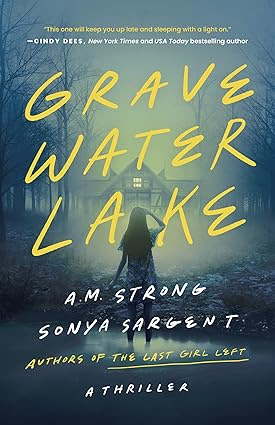
"Gravewater Lake"

New from Thomas & Mercer: Gravewater Lake: A Thriller by A.M. Strong and Sonya Sargent.

About the book, from the publisher:

A woman who can’t remember her past encounters a mysterious stranger in a chilling novel of mounting psychological suspense by the authors of The Last Girl Left.

She wakes on the shore of a remote lake in the middle of the night, freezing and afraid. With no memory of who she is or how she got there, she stumbles frantically toward the lights of a house. The handsome stranger who lives there is shocked to see a woman on his doorstep and takes her in.

Trapped by a winter storm and cut off from the outside world, she starts to suspect that all is not right with the house on Gravewater Lake―or the man, who says his name is Gregg. Because there are whispers in the night, and phantom footsteps pace the halls. Is Gregg hiding a dark secret, or is she losing her mind?

As she struggles to remember her past and make sense of her present, she soon discovers that people are not always who they seem, and the truth might be more deadly than she could ever have imagined.
Visit the website of A.M. Strong and Sonya Sargent.

--Marshal Zeringue