Saturday, November 4, 2023

"The Star and the Strange Moon"

New from Orbit Books: The Star and the Strange Moon by Constance Sayers.

About the book, from the publisher:

From the author of A Witch in Time comes a haunting tale of ambition, obsession, and the eternal mystery and magic of film.

1968: Actress Gemma Turner once dreamed of stardom. Unfortunately, she’s on the cusp of slipping into obscurity. When she’s offered the lead in a radical new horror film, Gemma believes her luck has finally changed. But L’Etrange Lune’s set is not what she expected. The director is eccentric, and the script doesn’t make sense.

Gemma is determined to make this work. It’s her last chance to achieve her dream—but that dream is about to derail her life. One night, between the shadows of an alleyway, Gemma disappears on set and is never seen again. Yet, Gemma is still alive. She’s been transported into the film and the script—and the monsters within it—are coming to life. She must play her role perfectly if she hopes to survive.

2015: Gemma Turner’s disappearance is one of film history’s greatest mysteries—one that’s haunted film student Christopher Kent ever since he saw his first screening of L’Etrange Lune. The screenings only happen once a decade and each time there is new, impossible footage of Gemma long after she vanished. Desperate to discover the truth, Christopher risks losing himself. He’ll have to outrun the cursed legacy of the film—or become trapped by it forever.
Visit Constance Sayers's website.

My Book, The Movie: A Witch in Time.

The Page 69 Test: A Witch in Time.

Writers Read: Constance Sayers (February 2020).

--Marshal Zeringue

"Merze Tate"

New from Yale University Press: Merze Tate: The Global Odyssey of a Black Woman Scholar by Barbara D. Savage.

About the book, from the publisher:

A powerful and inspiring biography of Merze Tate, a trailblazing Black woman scholar and intrepid world traveler

Born in rural Michigan during the Jim Crow era, the bold and irrepressible Merze Tate (1905–1996) refused to limit her intellectual ambitions, despite living in what she called a “sex and race discriminating world.” Against all odds, the brilliant and hardworking Tate earned degrees in international relations from Oxford University in 1935 and a doctorate in government from Harvard in 1941. She then joined the faculty of Howard University, where she taught for three decades of her long life spanning the tumultuous twentieth century.

This book revives and critiques Tate’s prolific and prescient body of scholarship, with topics ranging from nuclear arms limitations to race and imperialism in India, Asia, the Pacific, and Africa. Tate credited her success to other women, Black and white, who helped her realize her dream of becoming a scholar. Her quest for research and adventure took her around the world twice, traveling solo with her cameras.

Barbara Savage’s skilled rendering of Tate’s story is built on more than a decade of research. Tate’s life and work challenge provincial approaches to African American and American history, women’s history, the history of education, diplomatic history, and international thought.
--Marshal Zeringue

Friday, November 3, 2023

"A Very Inconvenient Scandal"

New from MIRA Books: A Very Inconvenient Scandal: A novel by Jacquelyn Mitchard.

About the book, from the publisher:

From #1 New York Times bestselling author Jacquelyn Mitchard comes a page-turning family drama that explores the emotional consequences of loyalty, deception and jealousy.

Stunned by her recently widowed father’s reckless behavior, a young woman must learn to navigate a new world—where the people she should trust the most have become strangers she cannot trust at all.

Frankie Attleboro returns home to Cape Cod with thrilling news. She’s met the love of her life, and they’re getting married with a baby on the way. That’s the moment her father makes his own jaw-dropping announcement: at sixty, he’s getting married as well, to Frankie’s best friend, Ariel, who is also pregnant, and due soon.

As Frankie and Ariel struggle to adjust to their new relationship, Ariel’s estranged mother, Carlotta, returns after a decade-long absence. She claims to be a changed woman—but is she really? And where has she been all these years? Frankie is suspicious, and as Carlotta’s unpredictable behavior intensifies, Frankie must untangle the threads of the past to protect Ariel’s future—and her own.

"The characters and relationships are all smartly drawn, and the narrative is shot through with plenty of humor and scandal. Mitchard fans will lap this up."—Publishers Weekly
Visit Jacquelyn Mitchard's website.

My Book, the Movie: Two If by Sea.

Writers Read: Jacquelyn Mitchard (March 2016).

The Page 69 Test: Two If by Sea.

The Page 69 Test: The Good Son.

Q&A with Jacquelyn Mitchard.

My Book, The Movie: The Good Son.

--Marshal Zeringue

"The Counterhuman Imaginary"

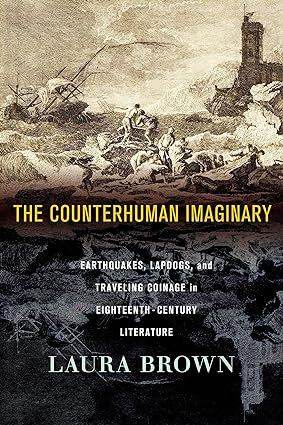
New from Cornell University Press: The Counterhuman Imaginary: Earthquakes, Lapdogs, and Traveling Coinage in Eighteenth-Century Literature by Laura Brown.

About the book, from the publisher:

The Counterhuman Imaginary proposes that alongside the historical, social, and institutional structures of human reality that seem to be the sole subject of the literary text, an other-than-human world is everywhere in evidence. Laura Brown finds that within eighteenth-century British literature, the human cultural imaginary can be seen, equally, as a counterhuman imaginary―an alternative realm whose scope and terms exceed human understanding or order.

Through close readings of works by Daniel Defoe, Jonathan Swift, and Alexander Pope, along with lapdog lyrics, circulation narratives that give agency to inanimate objects like coins and carriages, and poetry about the Lisbon earthquake of 1755, Brown traces the ways presence and power of the nonhuman―weather, natural disasters, animals, even the concept of love―not only influence human creativity, subjectivity, and history but are inseparable from them. Traversing literary theory, animal studies, new materialism, ecocriticism, and affect theory, The Counterhuman Imaginary offers an original repudiation of the centrality of the human to advance an integrative new methodology for reading chaos, fluidity, force, and impossibility in literary culture.
--Marshal Zeringue

Thursday, November 2, 2023

"Just Lizzie"

New from Clarion Books: Just Lizzie by Karen Wilfrid.

About the book, from the publisher:

There’s the part of me that doesn’t understand kissing or cuteness or attraction, and then there’s the part of me that feels so lonely. How do I make sense of those two parts? Maybe I’ll never make sense of them.

What do you do when there's a question inside you that feels so big, you don't know how to put words to it? How do you even begin to ask it?

Fourteen-year-old Lizzie is experiencing a lot of change: her family had to move after the incident with their neighbor, leaving behind not only her beloved apple tree, but what feels like her childhood along with it. Lizzie's brother is too busy for her in his first semester of college and her friends are more interested in dating than dolls. It’s hard not to feel left behind, especially as she tries to explain the fact that she still has zero interest in boys, girls, or the baffling behavior known as “flirting.”

But just as Lizzie’s world feels like its closing in, a class lesson on asexual reproduction in plants piques her curiosity, leading her to look up whether people can be asexual too—and suddenly, her world opens up. Lizzie finally finds an identity, a word for all her messy, unnamable feelings that feels like it fits, although she quickly realizes that a label isn’t enough if no one believes it’s real.

Accessible, moving, and compassionate, Just Lizzie effortlessly braids a nuanced individual journey of identity with the bittersweet angst of growing up, growing apart, and learning there are many ways to live and love.
Visit Karen Wilfrid's website.

--Marshal Zeringue

"Get Shown the Light"

New from Duke University Press: Get Shown the Light: Improvisation and Transcendence in the Music of the Grateful Dead by Michael Kaler.

About the book, from the publisher:

Of all the musical developments of rock in the 1960s, one in particular fundamentally changed the music’s structure and listening experience: the incorporation of extended improvisation into live performances. While many bands—including Cream, Pink Floyd, and the Velvet Underground—stretched out their songs with improvisations, no band was more identified with the practice than the Grateful Dead. In Get Shown the Light Michael Kaler examines how the Dead’s dedication to improvisation stemmed from their belief that playing in this manner enabled them to touch upon transcendence. Drawing on band testimonials and analyses of early recordings, Kaler traces how the Dead developed an approach to playing music that they believed would facilitate their spiritual goals. He focuses on the band’s early years, the significance of their playing Ken Kesey’s Acid Test parties, and their evolving exploration of the myriad musical and spiritual possibilities that extended improvisation afforded. Kaler demonstrates that the Grateful Dead developed a radical new way of playing rock music as a means to unleash the spiritual and transformative potential of their music.
--Marshal Zeringue

"Artifacts of An Ex"

New from Wednesday Books: Artifacts of An Ex by Jennifer Chen.

About the book, from the publisher:

In the tradition of Jenny Han and Emma Lord, Jennifer Chen’s Artifacts of an Ex is a story of love, art, and finding your way when everything you know has changed completely.

When Chloe Chang gets dumped via USPS after moving across the county from NYC to LA, her first instinct is to throw her box of memories in the garbage. Instead, she starts buying other teenagers’ break-up boxes to create an art exhibit, Heartifacts. Opening night is going great, until she spots Daniel Kwak illicitly filming his best friend’s reaction to his ex’s box. When she tries to stop him, an intense discussion ends up launching a creative partnership and friendship… and a major crush for Chloe.

There’s just one problem: Daniel is dead set on not being another rebound.

Five times he’s been the guy who makes the girls he’s dating realize they want to get back with their ex. And he refuses for there to be a sixth. She insists she’s over her ex, but when he shows up unexpectedly with his new girlfriend, it turns out Daniel was right. She isn’t ready for a new relationship.

She throws herself into making Heartifacts successful, but flashy influencers threaten her original vision of the exhibit. To create the exhibit she’s always wanted, Chloe needs to go back to basics, learn to work with artists in a more collaborative way, and discover what love can be. Only then will she convince Daniel she’s truly ready for everything they could be to one another.
Visit Jennifer Chen's website.

--Marshal Zeringue

"The Promise of Welfare"

New from Oxford University Press: The Promise of Welfare in the Postwar British and Anglophone Novel: States of Repair by Kelly M. Rich.

About the book, from the publisher:

The Promise of Welfare in the Postwar British Novel offers a new literary history of the Second World War and its aftermath by focusing on wartime visions of rebuilding Britain. Shifting attention from the "People's War" to the "People's Peace," this book shows that literature returns to the historic transition from warfare to welfare to narrate its transformative social potential and darker failures. The welfare state envisioned that managing individuals' private lives would result in a more coherent and equitable community, a promise encapsulated in the 1942 Beveridge Report's promise of care from the "cradle to the grave." The postwar novel reveals the intimate effects that follow when infrastructures of collective living seek to organize social interaction, tracing these effects through quasi-administrated home spaces such as girls' hostels, makeshift sanatoria, and experimental schools.

Mid-century writers including Elizabeth Bowen, Muriel Spark, and Samuel Selvon used the militarized Home Front to present postwar Britain as a zone of lost privacy and new collective logics. As the century progressed, and as the unrealized dreams of welfare came to be dismantled, authors including Alan Hollinghurst, Michael Ondaatje, and Kazuo Ishiguro registered an unfulfilled nostalgia for a Britain that never was, situating British domestic policies within trajectories of historic and social violence. Contemporary fiction continues to reanimate the transition from a warfare state to a welfare state, preserving its transformative potential while redefining its possible futures. With this long view of postwar fiction, this volume demonstrates the holding power of welfare's promises of repair and Britain's mid-century on the British cultural imagination.
Visit Kelly M. Rich's website.

--Marshal Zeringue

Wednesday, November 1, 2023

"The General and Julia"

New from Atria Books: The General and Julia: A Novel by Jon Clinch.

About the book, from the publisher:

Ulysses S. Grant reflects on the crucial moments of his life as a husband, a father, a general, and a president while writing his memoirs and reckoning with his complicated legacy in this epic and intimate work of “superb historical fiction” (Booklist, starred review).

Barely able to walk and rendered mute by the cancer metastasizing in his throat, Ulysses S. Grant is scratching out words, hour after hour, day after day. Desperate to complete his memoirs before his death so his family might have some financial security and he some redemption, Grant journeys back in time.

He had once been the savior of the Union, the general to whom Lee surrendered at Appomattox, a twice-elected president who fought for the civil rights of Black Americans and against the rising Ku Klux Klan, a plain farmer-turned-business magnate who lost everything to a Wall Street swindler, a devoted husband to his wife Julia, and a loving father to four children. In this gorgeously rendered and moving novel, Grant rises from the page in all of his contradictions and foibles, his failures and triumphs.

Moving from blood-stained battlefields to Gilded Age New York, the novel explores how Grant’s own views on race and Reconstruction changed over time. “A graceful, moving narrative” (Kirkus Reviews, starred review) from historical fiction master Jon Clinch, this evocatively crafted novel breathes fresh life into an American icon.
The Page 69 Test: Finn.

--Marshal Zeringue

"The Hijacking of American Flight 119"

New from Oxford University Press: The Hijacking of American Flight 119: How D.B. Cooper Inspired a Skyjacking Craze and the FBI's Battle to Stop It by John Wigger.

About the book, from the publisher:

He pulled off what some deem the crime of the century: skyjacking a commercial jetliner, collecting a ransom of $200,000, parachuting off the aft stairs of the Boeing 727 into the night, and simply disappearing. Since November 1971, "D.B. Cooper"―no one knows his real name or identity―has become a figure of enduring fascination and obsession. The FBI pursued him for over forty years, before closing the case and leaving it unsolved.

Unsolved, perhaps, but much admired. D.B. Cooper's exploit over the skies of the American Northwest has inspired books, films, and endless speculation. What's less known is that it inspired imitators. None were more daring than the hijacker of American Airlines Flight 119. After commandeering the flight from St. Louis with a machine gun and collecting $502,500 in ransom, he parachuted out over Indiana. Unlike Cooper, he was tracked down.

In The Hijacking of American Flight 119, John Wigger explores the wave of hijackings that swept over commercial flight between 1961 and 1972. One hijacker ran across the ramp in Reno, Nevada with a pillowcase over his head, gun in hand, to seize a United Airlines flight. Another collected a large ransom in Washington, D.C. before jumping over Honduras. Yet another rode a bicycle across the tarmac with a rifle strapped to the handlebars. Motivations involved an admixture of ideology, greed, derring-do, and a desperate need to be somebody. What they had in common was that their exploits transfixed the nation's attention, bringing about a transformation in airline security that remains with us still.

With its focus on the parachute hijackers, Wigger's book gathers together the stories of this period of daring criminality and recounts them in gripping fashion, showing their effect on the public, the media, and law enforcement. Using never-before- published interviews and first-hand accounts, he brings to life one of the most chaotic and fascinating periods in American aviation history.
--Marshal Zeringue