Saturday, August 27, 2022

"The Means"

New from Mariner Books: The Means: A Novel by Amy Fusselman.

About the book, from the publisher:

The debut novel from “wholly original” (Vogue) memoirist Amy Fusselman, a tragicomic family saga that skewers contemporary issues of money, motherhood, and class through a well-to-do woman’s quest to buy a Hamptons beach house.

Shelly Means, a wealthy stay-at-home mom and disgraced former PTA president, is poised to get the one thing in life she really wants: a beach house in the Hamptons. Who would have guessed that Shelly, the product of frugal Midwesterners, or her husband George, an unrepentant thrift shopper, would ever be living among such swells? But Shelly believes it’s possible. It might be a very small house, and it might be in the least-fancy part of the Hamptons. But Shelly has a vision board, an architect, and a plan.

But what should be a simple real estate transaction quickly goes awry as Shelly’s new neighbors disapprove of her proposed shipping container house at the same time that George’s lucrative work as a VoiceOver artist dries up. But Shelly is dogged. She knows how to go into beast mode. But will it ever be enough to realize her beach house dreams?

A novel of real estate, ambition, family, and money from “one of our best interrogators of how we live now, and how we should live” (Dave Eggers), The Means is also a fantastical, fast-moving and very funny exploration of class, wealth, and the value of work.
Visit Amy Fusselman's website.

--Marshal Zeringue

"Proving Pregnancy"

New from The University of North Carolina Press: Proving Pregnancy: Gender, Law, and Medical Knowledge in Nineteenth-Century America by Felicity M. Turner.

About the book, from the publisher:

Examining infanticide cases in the United States from the late eighteenth to the late nineteenth centuries, Proving Pregnancy documents how women—Black and white, enslaved and free—gradually lost control over reproduction to male medical and legal professionals. In the first half of the nineteenth century, community-based female knowledge played a crucial role in prosecutions for infanticide: midwives, neighbors, healers, and relatives were better acquainted with an accused woman's intimate life, the circumstances of her pregnancy, and possible motives for infanticide than any man. As the century progressed, women accused of the crime were increasingly subject to the scrutiny of white male legal and medical experts educated in institutions that reinforced prevailing ideas about the inferior mental and physical capacities of women and Black people. As Reconstruction ended, the reach of the carceral state expanded, while law and medicine simultaneously privileged federal and state regulatory power over that of local institutions. These transformations placed all women's bodies at the mercy of male doctors, judges, and juries in ways they had not been before.

Reframing knowledge of the body as property, Felicity M. Turner shows how, at the very moment when the federal government expanded formal civil and political rights to formerly enslaved people, the medical profession instituted new legal regulations across the nation that restricted access to knowledge of the female body to white men.
--Marshal Zeringue

Friday, August 26, 2022

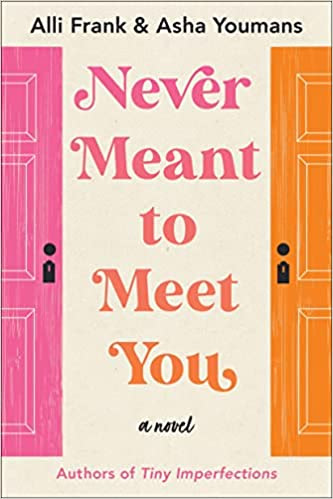
"Never Meant to Meet You"

Coming October 1 from Montlake: Never Meant to Meet You: A Novel by Alli Frank and Asha Youmans.

About the book, from the publisher:

From the authors of Tiny Imperfections comes a riotously funny, emotionally real look at race and religion, love and heartache, and the realities of parenting through it all.

Self-appointed fixer of other people’s woes Marjette Lewis is uncharacteristically determined to keep to her side of the driveway when it comes to her flawless neighbor Noa Abrams. Professionally, Marjette has her hands full as she prepares for a new class of kindergarteners and her first year of teaching without her best friend, Judy, as campus “Black-up.” And at home, her son’s budding manhood challenges her expectations, and her vexing ex-husband continues to be a thorn in her side.

But when tragedy strikes Marjette’s street, and an unexpected child shows up on the first day of school with an uncle who has all the class moms aflutter, Marjette is forced to contend with both her neighbor and her own heartache over losing the life she once thought was guaranteed. Through laughter, tears, and the gift of found family, Marjette and Noa navigate the rituals of loss together and discover the strength to remake their lives―whether they meant to or not.
Visit the Alli + Asha website.

--Marshal Zeringue

"A Death on W Street"

New from PublicAffairs: A Death on W Street: The Murder of Seth Rich and the Age of Conspiracy by Andy Kroll.

About the book, from the publisher:

A true-crime story for the post-truth era

In the early hours of July 10, 2016, gunshots rang out and a young man lay fatally wounded on a quiet Washington, DC, street. But who killed Seth Rich? When he was buried in his hometown, his rabbi declared: “There are no answers for a young man gunned down in the prime of his life.” The rabbi was wrong. There were in fact many answers, way too many.

In the absence of an arrest, a howling mob filled the void. Wild speculation and fantastical theories surfaced on social media and gained traction thanks to a high-level cast of provocateurs. But it wasn’t until Fox News took the rumors from the fringes to the mainstream that Seth Rich’s life and death grew into something altogether unexpected—one of the foundational conspiracy theories of modern times.

A Death on W Street unravels this gripping saga of murder, madness, and political chicanery, one that would ensnare Hillary Clinton and Steve Bannon, a popular pizzeria in northwest DC and the most powerful voices in American media. It's the story of an idealistic twenty-seven-year-old political staffer who became a tragic victim of the culture wars, until his family decided that they had no choice but to defend his name and put an end to the cruel deceptions that surrounded his death.

This is the definitive story of Seth Rich, of those who tried to weaponize his memory in a war of words unlike any other, and of one family’s crusade to protect the truth against all odds.
Visit Andy Kroll's website.

--Marshal Zeringue

"The Deceptions"

New from Catapult: The Deceptions: A Novel by Jill Bialosky.

About the book, from the publisher:

An explosive tale of art and myth, desire and betrayal, from New York Times best-selling author Jill Bialosky

Something terrible has happened and I don’t know what to do. An unnamed narrator’s life is unraveling. Her only child has left home, and her twenty-year marriage is strained. Anticipation about her soon-to-be-released book of poetry looms. She seeks answers to the paradoxes of love, desire, and parenthood among the Greek and Roman gods at the Metropolitan Museum of Art. As she passes her days teaching at a boys’ prep school, spending her off-hours sequestered in the museum's austere galleries, she is haunted by memories of a yearlong friendship with a colleague, a fellow poet struggling with his craft. As secret betrayals and deceptions come to light and rage threatens to overwhelm her, the pantheon of gods assume remarkably vivid lives of their own, forcing her to choose between reality and myth in an effort to free herself from the patriarchal constraints of the past and embrace a new vision for her future.

The Deceptions is a page-turning and seductively told exploration of female sexuality and ambition as well as a human drama that dares to test the stories we tell ourselves. It is also a brilliant investigation of a life caught between the dueling magnetic poles of privacy and its appropriation in art and literature. Celebrated poet, memoirist, and novelist Jill Bialosky has reached new and daring heights in her boldest work yet.
Visit Jill Bialosky's website.

--Marshal Zeringue

"Climate Future"

New from Oxford University Press: Climate Future: Averting and Adapting to Climate Change by Robert S. Pindyck.

About the book, from the publisher:

Most people would probably agree on what should be done to avert severe climate change: The world must reduce CO2 emissions as much and as quickly as possible. But we must also ask what will be done. Is it realistic to expect worldwide emissions to fall rapidly enough to prevent severe climate change? And if we conclude it is not realistic, and so higher temperatures and rising sea levels are likely, what should we do? What actions should we take now to reduce the likely impact of climate change?

Whatever climate policies are adopted, there will be a great deal of uncertainty over what will happen as a result. In Climate Future, Robert Pindyck, an authority on the economics of climate change and global catastrophes, explains what we know and what we don't know about the extent of climate change and its impact, why there is so much uncertainty, and what it means for climate policy. This book shows that given the economic and political realities, it is simply not realistic to expect emission reductions needed to avert substantial global warming. Pindyck argues that investments in adaptation-developing new hybrid crops, discouraging building in flood-prone or wildfire-prone areas, building sea walls and dikes, and geoengineering-are needed to insure against catastrophic climate change events. We should invest now in adaptation, and Pindyck shows how that can be done.
--Marshal Zeringue

Thursday, August 25, 2022

"The Ways We Hide"

New from Sourcebooks: The Ways We Hide by Kristina McMorris.

About the book, from the publisher:

As a little girl raised amid the hardships of Michigan's Copper Country, Fenna Vos learned to focus on her own survival. That ability sustains her even now as the Second World War rages in faraway countries. Though she performs onstage as the assistant to an unruly escape artist, behind the curtain she's the mastermind of their act. Ultimately, controlling her surroundings and eluding traps of every kind helps her keep a lingering trauma at bay.

Yet for all her planning, Fenna doesn't foresee being called upon by British military intelligence. Tasked with designing escape aids to thwart the Germans, MI9 seeks those with specialized skills for a war nearing its breaking point. Fenna reluctantly joins the unconventional team as an inventor. But when a test of her loyalty draws her deep into the fray, she discovers no mission is more treacherous than escaping one's past.

Inspired by stunning true accounts, The Ways We Hide is a gripping story of love and loss, the wars we fight—on the battlefields and within ourselves—and the courage found in unexpected places.
Visit Kristina McMorris's website.

--Marshal Zeringue

"Skirts"

New from St. Martin's Press: Skirts: Fashioning Modern Femininity in the Twentieth Century by Kimberly Chrisman-Campbell.

About the book, from the publisher:

In a sparkling, beautifully illustrated social history, Skirts traces the shifting roles of women over the twentieth century through the era’s most iconic and influential dresses.

While the story of women’s liberation has often been framed by the growing acceptance of pants over the twentieth century, the most important and influential female fashions of the era featured skirts. Suffragists and soldiers marched in skirts; the heroines of the Civil Rights Movement took a stand in skirts. Frida Kahlo and Georgia O’Keeffe revolutionized modern art and Marie Curie won two Nobel Prizes in skirts. When NASA put a man on the moon, “the computer wore a skirt,” in the words of one of those computers, mathematician Katherine G. Johnson. As women made strides towards equality in the vote, the workforce, and the world at large, their wardrobes evolved with them. They did not need to "wear the pants" to be powerful or progressive; the dress itself became modern as designers like Mariano Fortuny, Coco Chanel, Jean Patou, and Diane von Furstenberg redefined femininity for a new era.

Kimberly Chrisman-Campbell's Skirts looks at the history of twentieth-century womenswear through the lens of game-changing styles like the little black dress and the Bar Suit, as well as more obscure innovations like the Taxi dress or the Pop-Over dress, which came with a matching potholder. These influential garments illuminate the times in which they were first worn—and the women who wore them—while continuing to shape contemporary fashion and even opening the door for a genderfluid future of skirts. At once an authoritative work of history and a delightfully entertaining romp through decades of fashion, Skirts charts the changing fortunes, freedoms, and aspirations of women themselves.
Visit Kimberly Chrisman-Campbell's website.

--Marshal Zeringue

"The Secret of Elephants"

New from Lake Union: The Secret of Elephants by Vasundra Tailor.

About the book, from the publisher:

Navsari, India. Penniless and trapped in a loveless marriage, Nirmala spends her days anxiously caring for her sick young son, Varun. Looming over Nirmala’s impoverished home is an imposing mansion built by her grandfather, and from its balcony her cruel aunt scorns them, refusing to help in any way.

But when a mysterious letter addressed to her long-dead father arrives from Zimbabwe, it opens a door to a past Nirmala never knew existed and a future she never imagined possible. If the contents of the letter can be believed, not only does she have family in Africa, but they might also hold the answers to a family mystery that spans three generations.

While travelling to Zimbabwe might lead to a brighter future for Nirmala and her son, it could also reignite the bitter family feud that condemned her family to poverty. Nirmala is ready to risk it all to uncover the truth, but how will she cope when this journey changes her life forever?
Follow Vasundra Tailor on Twitter.

--Marshal Zeringue

"Keeping Family Secrets"

Coming November 8 from NYU Press: Keeping Family Secrets: Shame and Silence in Memoirs from the 1950s by Margaret K. Nelson.

About the book, from the publisher:

From teen pregnancy and gay sexuality to Communism and disability, the startling secrets that families kept during the Cold War era

All families have secrets but the facts requiring secrecy change with time. Nowadays A lesbian partnership, a “bastard” son, an aunt who is a prostitute, or a criminal grandfather might be of little or no consequence but could have unraveled a family at an earlier moment in history. Margaret K. Nelson is interested in how families keep secrets from each other and from outsiders when to do otherwise would risk eliciting not only embarrassment or discomfort, but profound shame and, in some cases, danger. Drawing on over 150 memoirs describing childhoods in the period between the aftermath of World War II and the 1960s, Nelson highlights the importance of history in creating family secrets and demonstrates the use of personal stories to understand how people make sense of themselves and their social worlds.

Keeping Family Secrets uncovers hidden stories of same-sex attraction among boys, unwed pregnancies among teenage girls, the institutionalization of children with mental and physical disabilities, participation in left-wing political activities, adoption, and Jewish ancestry. The members of ordinary families kept these issues secret to hide the disconnect between the reality of their own family and the prevailing ideals of what a family should be. Personal accounts reveal the costs associated with keeping family secrets, as family members lie, hurl epithets, inflict abuse, and even deny family membership to protect themselves from the shame and danger of public knowledge. Keeping Family Secrets sheds light not only on decades-old secrets but pushes us to confront what secrets our families keep today.
The Page 99 Test: Parenting Out of Control.

The Page 99 Test: Like Family.

--Marshal Zeringue