Sunday, March 24, 2024

"An Inconvenient Wife"

New from Pegasus Books: An Inconvenient Wife: A Modern Tudor Mystery by Karen E. Olson.

About the book, from the publisher:

This astonishing crime novel—inspired by the Tudor era—takes the reader into the world of Kate Parker, who has just married billionaire Hank Tudor when a headless body is discovered near their summer home...

Kate Parker knows what she’s getting into when she marries billionaire businessman Hank Tudor—she’s his sixth wife, after all, and was by his side (as his assistant) when his fifth marriage to actress Caitlyn Howard fell apart.

But honeymoon plans go awry when a headless body is discovered near Hank’s summer home, forcing Kate to contend with two more of his exes: Catherine Alvarez—the first—who lives as a shut-in with her computers, carefully following Tudor Enterprises; and Anna Klein—the fourth—who runs a bed-and-breakfast where she and her wife keep a steady eye on things—particularly Hank’s children, Lizzie and Teddy.

In this clever and suspenseful reimagining of Tudor era betrayals, these three women become entwined in a deadly game of cat and mouse—with each other, Hank, and Hank’s brilliant fixer, Tom Cromwell—as Kate seeks to solve the puzzle of who the murdered woman is, who killed her, and whether her death has any connection to the other headless body from eight years ago.
Visit Karen E. Olson's website.

--Marshal Zeringue

"Screening the Operatic Stage"

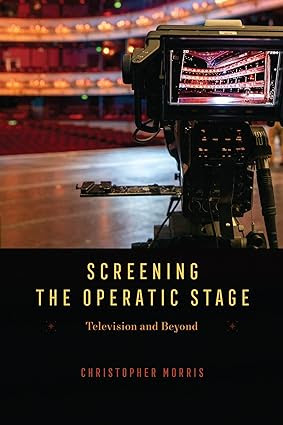
New from the University of Chicago Press: Screening the Operatic Stage: Television and Beyond by Christopher Morris.

About the book, from the publisher:

An ambitious study of the ways opera has sought to ensure its popularity by keeping pace with changes in media technology.

From the early days of television broadcasts to today’s live streams, opera houses have embraced technology as a way to reach new audiences. But how do these new forms of remediated opera extend, amplify, or undermine production values, and what does the audience gain or lose in the process? In Screening the Operatic Stage, Christopher Morris critically examines the cultural implications of opera’s engagement with screen media.

Foregrounding the potential for a playful exchange and self-awareness between stage and screen, Morris uses the conceptual tools of media theory to understand the historical and contemporary screen cultures that have transmitted the opera house into living rooms, onto desktops and portable devices, and across networks of movie theaters. If these screen cultures reveal how inherently “technological” opera is as a medium, they also highlight a deep suspicion among opera producers and audiences toward the intervention of media technology. Ultimately, Screening the Operatic Stage shows how the conventions of televisual representation employed in opera have masked the mediating effects of technology in the name of fidelity to live performance.
--Marshal Zeringue

Saturday, March 23, 2024

"Something Kindred"

New from Farrar, Straus and Giroux (BYR): Something Kindred by Ciera Burch.

About the book, from the publisher:

Magical realism meets Southern Gothic in this commanding young adult debut from Ciera Burch about true love, the meaning of home, and the choices that haunt us.

Welcome to Coldwater. Come for the ghosts, stay for the drama.

Jericka Walker had planned to spend the summer before senior year soaking up the sun with her best friend on the Jersey Shore. Instead she finds herself in Coldwater, Maryland, a small town with a dark and complicated past where her estranged grandmother lives—someone she knows only two things about: her name and the fact that she left Jericka’s mother and uncle when they were children. But now Jericka's grandmother is dying, and her mother has dragged Jericka along to say goodbye.

As Jericka attempts to form a connection with a woman she's never known, and adjusts to life in a town where everything closes before dinner, she meets “ghost girl” Kat, a girl eager to leave Coldwater and more exciting than a person has any right to be. But Coldwater has a few unsettling secrets of its own. The more you try to leave, the stronger the town’s hold. As Jericka feels the chilling pull of her family’s past, she begins to question everything she thought she knew about her mother, her childhood, and the lines between the living and the dead.
Visit Ciera Burch's website.

--Marshal Zeringue

"The First Last Man"

Coming soon from University of Pennsylvania Press: The First Last Man: Mary Shelley and the Postapocalyptic Imagination by Eileen M. Hunt.

About the book, from the publisher:

Beyond her most famous creation—the nightmarish vision of Frankenstein’s Creature—Mary Shelley’s most enduring influence on politics, literature, and art perhaps stems from the legacy of her lesser-known novel about the near-extinction of the human species through war, disease, and corruption. This novel, The Last Man (1826), gives us the iconic image of a heroic survivor who narrates the history of an apocalyptic disaster in order to save humanity—if not as a species, then at least as the practice of compassion or humaneness. In visual and musical arts from 1826 to the present, this postapocalyptic figure has transmogrified from the “last man” into the globally familiar filmic images of the “invisible man” and the “final girl.”

Reading Shelley’s work against the background of epidemic literature and political thought from ancient Greece to Covid-19, Eileen M. Hunt reveals how Shelley’s postapocalyptic imagination has shaped science fiction and dystopian writing from H. G. Wells, M. P. Shiel, and George Orwell to Octavia Butler, Margaret Atwood, and Emily St. John Mandel. Through archival research into Shelley’s personal journals and other writings, Hunt unearths Shelley’s ruminations on her own personal experiences of loss, including the death of young children in her family to disease and the drowning of her husband, Percy Bysshe Shelley. Shelley’s grief drove her to intensive study of Greek tragedy, through which she developed the thinking about plague, conflict, and collective responsibility that later emerges in her fiction. From her readings of classic works of plague literature to her own translation of Sophocles’s Oedipus Rex, and from her authorship of the first major modern pandemic novel to her continued influence on contemporary popular culture, Shelley gave rise to a tradition of postapocalyptic thought that asks a question that the Covid-19 pandemic has made newly urgent for many: What do humans do after disaster?
--Marshal Zeringue

"The Audacity"

New from Soho Press: The Audacity by Ryan Chapman.

About the book, from the publisher:

A bracing satire about the implosion of a Theranos-like company, a collapsing marriage, and a billionaires’ “philanthropy summit,” for fans of Hari Kunzru and The White Lotus.

In 72 hours, a blockbuster exposé will reveal Victoria Stevens’s multibillion-dollar startup as a massive fraud. And Victoria has gone missing. Has she faked her death, leaving her husband, Guy Sarvananthan, to face the fallout— and potential jail time? Should Guy flee to his native Sri Lanka, an outcast and a failure? Or embrace denial? Opting for the latter, he takes the corporate jet to a private Caribbean island, where the 0.0001% have gathered to decide which one of the world’s biggest problems to “eradicate forever.” Guy drinks and drugs his way into oblivion, through manicured jungles and aboard superyachts, amid captains of industry, legions of staff, and unlikely saboteurs.

Meanwhile, Victoria narrates her side of the story from an off-the-grid location in the California desert. In scribbled diary entries shot through with cultish self-help mantras, she plots her comeback, confident she’ll prove everyone wrong. Again.

Ryan Chapman’s incisive novel is a swan dive into the abyss and “Martin Amis’s Money for really late, late capitalism” (Amitava Kumar, author of A Time Outside This Time).
Visit Ryan Chapman's website.

The Page 69 Test: Riots I Have Known.

--Marshal Zeringue

"The Graft Hybrid"

Coming soon from the University of Pittsburgh Press: The Graft Hybrid: Challenging Twentieth-Century Genetics by Matthew Holmes.

About the book, from the publisher:

The global triumph of Mendelian genetics in the twentieth century was not a foregone conclusion, thanks to the existence of graft hybrids. These chimeral plants and animals are created by grafting tissue from one organism to another with the goal of passing the newly hybridized genetic material on to their offspring. But prevailing genetic theory insisted that heredity was confined to the sex cells and there was no inheritance of characteristics acquired during an organism’s lifetime. Under sustained attacks from geneticists, scientific belief in the existence of graft hybrids slowly began to decline. Yet ordinary horticulturalists and breeders continued to believe in the power of grafting. Matthew Holmes tells the story of these organisms—which include multicolored chickens and black nightshades that grew tomatoes—and their enduring influence on twentieth-century biology. Their creators sought a goal as ambitious as the wildest dreams of genetic engineering today: to smash the barriers between species and freely exchange genes between organisms. The Graft Hybrid presents a greater understanding of the controversial history of graft hybrids, offering a crucial intervention in the history of genetics and the future of biological science.
Visit Matthew Holmes's website.

--Marshal Zeringue

"American Daughters"

New from William Morrow Paperbacks: American Daughters: A Novel by Piper Huguley.

About the book, from the publisher:

In the vein of America’s First Daughter, Piper Huguley’s historical novel delves into the remarkable friendship of Portia Washington and Alice Roosevelt, the daughters of educator Booker T. Washington and President Teddy Roosevelt.

At the turn of the twentieth century, in a time of great change, two women—separated by societal status and culture but bound by their expected roles as the daughters of famed statesmen—forged a lifelong friendship.

Portia Washington’s father Booker T. Washington was formerly enslaved and spent his life championing the empowerment of Black Americans through his school, known popularly as Tuskegee Institute, as well as his political connections. Dedicated to her father’s values, Portia contributed by teaching and performing spirituals and classical music. But a marriage to a controlling and jealous husband made fulfilling her dreams much more difficult.

When Theodore Roosevelt assumed the presidency, his eldest daughter Alice Roosevelt joined him in the White House. To try to win her father’s approval, she eagerly jumped in to help him succeed, but Alice’s political savvy and nonconformist behavior alienated as well as intrigued his opponents and allies. When she married a congressman, she carved out her own agendas and continued espousing women’s rights and progressive causes.

Brought together in the wake of their fathers’ friendship, these bright and fascinating women helped each other struggle through marriages, pregnancies, and political upheaval, supporting each other throughout their lives.

A provocative historical novel and revealing portrait, Piper Huguley’s American Daughters vividly brings to life two passionate and vital women who nurtured a friendship that transcended politics and race over a century ago.
Visit Piper Huguley's website.

--Marshal Zeringue

"Molds, Mushrooms, and Medicines"

New from Princeton University Press: Molds, Mushrooms, and Medicines: Our Lifelong Relationship with Fungi by Nicholas P. Money.

About the book, from the publisher:

The hidden role of fungi inside and all around us

From beneficial yeasts that aid digestion to toxic molds that cause disease, we are constantly navigating a world filled with fungi. Molds, Mushrooms, and Medicines explores the amazing ways fungi interact with our bodies, showing how our health and well-being depend on an immense ecosystem of yeasts and molds inside and all around us.

Nicholas Money takes readers on a guided tour of a marvelous unseen realm, describing how our immune systems are engaged in continuous conversation with the teeming mycobiome inside the body, and how we can fall prey to serious and even life-threatening infections when this peaceful coexistence is disturbed. He also sheds light on our complicated relationship with fungi outside the body, from wild mushrooms and cultivated molds that have been staples of the human diet for millennia to the controversial experimentation with magic mushrooms in the treatment of depression.

Drawing on the latest advances in mycology, Molds, Mushrooms, and Medicines reveals what scientists are learning about the importance of fungi to our lives, from their vital role in supporting the ecosystems on which we depend to their emerging uses in lifesaving medicine.
Visit Nik Money's website.

--Marshal Zeringue

Friday, March 22, 2024

"The Final Act of Juliette Willoughby"

Coming June 11 from Harper: The Final Act of Juliette Willoughby: A Novel by Ellery Lloyd.

About the book, from the publisher:

The gripping follow up to the “smart, stylish, and savage” (People) New York Times bestseller and Reese’s Book Club pick The Club—a twisty mystery involving a cursed wealthy family and a Surrealist painting which holds the key to three suspicious deaths over the course of a century.

Some women won't be painted out of history . . .

Everybody knows that in 1938, runaway heiress artist Juliette Willoughby perished in an accidental studio fire in Paris, alongside her masterpiece Self Portrait As Sphinx.

Fifty years later, two Cambridge art history students are confounded when they stumble across proof that the fire was no accident but something more sinister. What they uncover threatens the very foundation of Juliette’s aristocratic family and revives rumors of the infamous curse that has haunted the Willoughbys for generations.

But what does their discovery mean? And how is it connected to a brutal murder in present-day Dubai?

A tale of love and madness, obsession and revenge, The Final Act of Juliette Willoughby unravels the riddle posed by a Sphinx who refuses to reveal her secrets...
Visit Ellery Lloyd's website.

--Marshal Zeringue

"We, Us, and Them"

New from the University of Virginia Press: We, Us, and Them: Affect and American Nonfiction from Vietnam to Trump by Douglas Dowland.

About the book, from the publisher:

When Americans describe their compatriots, who exactly are they talking about? This is the urgent question that Douglas Dowland asks in We, Us, and Them. In search of answers, he turns to narratives of American nationhood written since the Vietnam War—stories in which the ostensibly strong state of the Union has been turned increasingly into an America of us versus them. Dowland explores how a range of writers across the political spectrum, including Hunter S. Thompson, James Baldwin, and J. D. Vance, articulate a particular vision of America with such strong conviction that they undermine the unity of the country they claim to extol. We, Us, and Them pinpoints instances in which criticism leads to cynicism, rage leads to apathy, and a broad vision narrows in our present moment.
--Marshal Zeringue