Tuesday, September 20, 2022

"River Woman, River Demon"

New from Blackstone: River Woman, River Demon: A Novel by Jennifer Givhan.

About the book, from the publisher:

When Eva’s husband is arrested for the murder of a friend, she must confront her murky past and embrace her magick to find out what really happened that night on the river.

Eva Santos Moon is a burgeoning Chicana artist who practices the ancient, spiritual ways of brujería and curanderisma, but she’s at one of her lowest points—suffering from disorienting blackouts, creative stagnation, and a feeling of disconnect from her magickal roots. When her husband, a beloved university professor and the glue that holds their family together, is taken into custody for the shocking murder of their friend, Eva doesn’t know whom to trust—least of all, herself. She soon falls under suspicion as a potential suspect, and her past rises to the surface, dredging up the truth about an eerily similar death from her childhood.

Struggling with fragmented memories and self-doubt, an increasingly terrified Eva fears that she might have been involved in both murders. But why doesn’t she remember? Only the dead women know for sure, and they’re coming for her with a haunting vengeance. As she fights to keep her family out of danger, Eva realizes she must use her magick as a bruja to protect herself and her loved ones, while confronting her own dark history.

River Woman, River Demon is a mysterious incantation of reckoning with the past and claiming one’s unique power and voice.
Visit Jennifer Givhan's website.

--Marshal Zeringue

"Switched On"

New from Oxford University Press: Switched On: Bob Moog and the Synthesizer Revolution by Albert Glinsky.

About the book, from the publisher:

The Moog synthesizer "bent the course of music forever" Rolling Stone declared.

Bob Moog, the man who did that bending, was a lovable geek with Einstein hair and pocket protectors. He walked into history in 1964 when his homemade contraption unexpectedly became a sensation---suddenly everyone wanted a Moog. The Beatles, The Doors, The Byrds, and Stevie Wonder discovered his synthesizer, and it came to be featured in seminal film scores including Apocalypse Now and A Clockwork Orange. The Moog's game-changing sounds saturated 60's counterculture and burst into the disco party in the 70's to set off the electronic dance music movement. Bob had singlehandedly founded the synth industry and become a star in the process.

But he was also going broke. Imitators copied his technology, the musicians' union accused him of replacing live players, and Japanese competitors started overtaking his work. He struggled to hang on to his inventions, his business, and his very name. Bob's story upends our notions of success and wealth, showing that the two don't always go together.

In Switched On, author Albert Glinsky draws on exclusive access to Bob Moog's personal archives and his probing interviews with Bob's family and a multitude of associates, for this first complete biography of the man and his work. Switched On takes the reader on a roller coaster ride at turns triumphant, heart-breaking, and frequently laugh out loud absurd---a nuanced trip through the public and private worlds of this legendary inventor who altered the course of music.
Visit Albert Glinsky's website.

--Marshal Zeringue

"Secrets of the Nile"

New from Minotaur Books: Secrets of the Nile: A Lady Emily Mystery (Volume 16) by Tasha Alexander.

About the book, from the publisher:

In a brilliant homage to Agatha Christie, critically acclaimed author Tasha Alexander sends Lady Emily to Egypt during British colonial rule to investigate a crime that leads back to the era of the Pharaohs.

In Secrets of the Nile, Lady Emily and her husband, Colin Hargreaves, have joined his formidable mother on a holiday to visit the exotic treasures of Egypt. Their host, Lord Bertram Deeley, is a renowned amateur British collector of antiquities, who has invited his closest friends on a lavish cruise up the Nile to his home at Luxor. But on the first night of their journey, he suddenly collapses after offering a welcome toast, a victim of the lethal poison cyanide. Who amongst this group of his nearest and dearest would want to kill their generous host?

Emily and Colin’s investigation soon reveals that even his closest friends had reasons to want him dead: was it the archeologist whose dig Deeley was poised to fund until he suddenly withdrew support? The powerful politician whose career Deeley had secretly destroyed? The dyspeptic aristocratic English spinster whose hired travelling companion seems determined to protect her employer? Or could it be Mrs. Hargreaves herself, who may have spurned the advances of Lord Deeley when they were both younger?

A key clue may lie with several ancient ushabtis, exquisite three-thousand-year-old sculptures that played a role in a hidden story from the time of Ancient Egypt, one of a sister’s unshakeable loyalty to her brother, a tale of betrayal and revenge. In an unforgettable finale, Emily and Colin gather their fellow travelers together to unmask a killer whose motive is as shocking as it is brilliant.
Visit Tasha Alexander's website.

Q&A with Tasha Alexander.

The Page 69 Test: The Dark Heart of Florence.

--Marshal Zeringue

"After Authoritarianism"

New from Cambridge University Press: After Authoritarianism: Transitional Justice and Democratic Stability by Monika Nalepa.

About the book, from the publisher:

Transitional justice – the act of reckoning with a former authoritarian regime after it has ceased to exist – has direct implications for democratic processes. Mechanisms of transitional justice have the power to influence who decides to go into politics, can shape politicians' behavior while in office, and can affect how politicians delegate policy decisions. However, these mechanisms are not all alike: some, known as transparency mechanisms, uncover authoritarian collaborators who did their work in secret while others, known as purges, fire open collaborators of the old regime. After Authoritarianism analyzes this distinction in order to uncover the contrasting effects these mechanisms have on sustaining and shaping the qualities of democratic processes. Using a highly disaggregated global transitional justice dataset, the book shows that mechanisms of transitional justice are far from being the epilogue of an outgoing authoritarian regime, and instead represent the crucial first chapter in a country's democratic story.
Visit Monika Nalepa's website.

--Marshal Zeringue

Monday, September 19, 2022

"Hester"

New from St. Martin's Press: Hester: A Novel by Laurie Lico Albanese.

About the book, from the publisher:

A vivid reimagining of the woman who inspired Hester Prynne, the tragic heroine of Nathaniel Hawthorne's The Scarlet Letter, and a journey into the enduring legacy of New England's witchcraft trials.

Isobel Gamble is a young seamstress carrying generations of secrets when she sets sail from Scotland in the early 1800s with her husband, Edward. An apothecary who has fallen under the spell of opium, his pile of debts have forced them to flee Glasgow for a fresh start in the New World. But only days after they've arrived in Salem, Edward abruptly joins a departing ship as a medic––leaving Isobel penniless and alone in a strange country, forced to make her way by any means possible.

When she meets a young Nathaniel Hawthorne, the two are instantly drawn to each other: he is a man haunted by his ancestors, who sent innocent women to the gallows––while she is an unusually gifted needleworker, troubled by her own strange talents. As the weeks pass and Edward's safe return grows increasingly unlikely, Nathaniel and Isobel grow closer and closer. Together, they are a muse and a dark storyteller; the enchanter and the enchanted. But which is which?

In this sensuous and hypnotizing tale, a young immigrant woman grapples with our country's complicated past, and learns that America's ideas of freedom and liberty often fall short of their promise. Interwoven with Isobel and Nathaniel's story is a vivid interrogation of who gets to be a "real" American in the first half of the 19th century, a depiction of the early days of the Underground Railroad in New England, and atmospheric interstitials that capture the long history of "unusual" women being accused of witchcraft. Meticulously researched yet evocatively imagined, Laurie Lico Albanese's Hester is a timeless tale of art, ambition, and desire that examines the roots of female creative power and the men who try to shut it down.
Visit Laurie Lico Albanese's website.

--Marshal Zeringue

"Anarchist Prophets"

New from Duke University Press: Anarchist Prophets: Disappointing Vision and the Power of Collective Sight by James R. Martel.

About the book, from the publisher:

In Anarchist Prophets James R. Martel juxtaposes anarchism with what he calls archism in order to theorize the potential for a radical democratic politics. He shows how archism—a centralized and hierarchical political form that is a secularization of ancient Greek and Hebrew prophetic traditions—dominates contemporary politics through a prophet’s promises of peace and prosperity or the threat of violence. Archism is met by anarchism, in which a community shares a collective form of judgment and vision. Martel focuses on the figure of the anarchist prophet, who leads efforts to regain the authority for the community that archism has stolen. The goal of anarchist prophets is to render themselves obsolete and to cede power back to the collective so as to not become archist themselves. Martel locates anarchist prophets in a range of philosophical, literary, and historical examples, from Hobbes and Nietzsche to Mary Shelley and Octavia Butler to Kurdish resistance in Syria and the Spanish Revolution. In so doing, Martel highlights how anarchist forms of collective vision and action can provide the means to overthrow archist authority.
--Marshal Zeringue

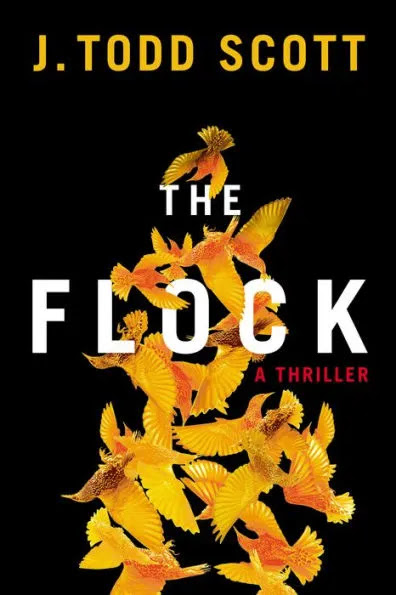
"The Flock"

New from Thomas & Mercer: The Flock by J. Todd Scott.

About the book, from the publisher:

From J. Todd Scott comes a chillingly engrossing thriller about a cult survivor who must confront the horrors of her past to ensure the safety of the future.

Ten years after a fiery raid kills her family, former cult member Sybilla “Billie” Laure has a completely new identity. She’s settled in rural Colorado with her daughter, hoping for a quieter life. But the world has other plans.

With wildfires raging and birds dropping from the sky, Billie wonders if her cult leader father’s apocalyptic predictions are finally coming true. When an intruder murders her husband and kidnaps her daughter, Billie has no choice but to confront the secrets of her past. But Billie’s journey has other perils, too―namely, a police chief hot on her trail, determined to expose the dangers of the defunct doomsday cult.

To save her daughter, Billie will have to go back to where it all began―to the ruined compound in New Mexico where the real threat is the truth.
Visit J. Todd Scott's website.

The Page 69 Test: High White Sun.

My Book, The Movie: High White Sun.

My Book, The Movie: This Side of Night.

The Page 69 Test: This Side of Night.

Q&A with J. Todd Scott.

The Page 69 Test: Lost River.

--Marshal Zeringue

"No Other Planet"

New from Cambridge University Press: No Other Planet: Utopian Visions for a Climate-Changed World by Mathias Thaler.

About the book, from the publisher:

Visions of utopia – some hopeful, others fearful – have become increasingly prevalent in recent times. This groundbreaking, timely book examines expressions of the utopian imagination with a focus on the pressing challenge of how to inhabit a climate-changed world. Forms of social dreaming are tracked across two domains: political theory and speculative fiction. The analysis aims to both uncover the key utopian and dystopian tendencies in contemporary debates around the Anthropocene; as well as to develop a political theory of radical transformation that avoids not only debilitating fatalism but also wishful thinking. This book juxtaposes theoretical interventions, from Bruno Latour to the members of the Dark Mountain collective, with fantasy and science fiction texts by N. K. Jemisin, Kim Stanley Robinson and Margaret Atwood, debating viable futures for a world that will look and feel very different from the one we live in right now.
Visit Mathias Thaler's website.

--Marshal Zeringue

Sunday, September 18, 2022

"Sweet, Soft, Plenty Rhythm"

New from Pantheon: Sweet, Soft, Plenty Rhythm: A Novel by Laura Warrell.

About the book, from the publisher:

It’s 2013, and Circus Palmer, a forty-year-old Boston-based trumpet player and old-school ladies’ man, lives for his music and refuses to be tied down. Before a gig in Miami, he learns that the woman who is secretly closest to his heart, the free-spirited drummer Maggie, is pregnant by him. Instead of facing the necessary conversation, Circus flees, setting off a chain of interlocking revelations from the various women in his life. Most notable among them is his teenage daughter, Koko, who idolizes him and is awakening to her own sexuality even as her mentally fragile mother struggles to overcome her long-failed marriage and rejection by Circus. Delivering a lush orchestration of diverse female voices, Warrell spins a provocative, soulful, and gripping story of passion and risk, fathers and daughters, wives and single women, and, finally, hope and reconciliation, in answer to the age-old question: how do we find belonging when love is unrequited?
Visit Laura Warrell's website.

--Marshal Zeringue

"Cartographic Memory"

New from Duke University Press: Cartographic Memory: Social Movement Activism and the Production of Space by Juan Herrera.

About the book, from the publisher:

In Cartographic Memory, Juan Herrera maps 1960s Chicano movement activism in the Latinx neighborhood of Fruitvale in Oakland, California, showing how activists there constructed a politics forged through productions of space. From Chicano-inspired street murals to the architecture of restaurants and shops, Herrera shows how Fruitvale’s communities and spaces serve as a palpable, living record of movement politics and achievements. Drawing on oral histories with Chicano activists, ethnography, and archival research, Herrera analyzes how activism has shaped Fruitvale. Herrera examines the ongoing nature of activism through nonprofit organizations and urban redevelopment projects like the Fruitvale Transit Village that root movements in place. Revealing that the social justice activism in Fruitvale fights for a space that does not yet exist, Herrera brings to life contentious politics about the nature of Chicanismo, Latinidad, and belonging while foregrounding the lasting social and material legacies of movements so often relegated to the past.
Visit Juan Herrera's website.

--Marshal Zeringue