Thursday, November 8, 2012

"The Covert Sphere"

New from Cornell University Press: The Covert Sphere: Secrecy, Fiction, and the National Security State by Timothy Melley.

About the book, from the publisher:

In December 2010 the U.S. Embassy in Kabul acknowledged that it was providing major funding for thirteen episodes of Eagle Four—a new Afghani television melodrama based loosely on the blockbuster U.S. series 24. According to an embassy spokesperson, Eagle Four was part of a strategy aimed at transforming public suspicion of security forces into something like awed respect. Why would a wartime government spend valuable resources on a melodrama of covert operations? The answer, according to Timothy Melley, is not simply that fiction has real political effects but that, since the Cold War, fiction has become integral to the growth of national security as a concept and a transformation of democracy.

In The Covert Sphere, Melley links this cultural shift to the birth of the national security state in 1947. As the United States developed a vast infrastructure of clandestine organizations, it shielded policy from the public sphere and gave rise to a new cultural imaginary, "the covert sphere." One of the surprising consequences of state secrecy is that citizens must rely substantially on fiction to “know,” or imagine, their nation's foreign policy. The potent combination of institutional secrecy and public fascination with the secret work of the state was instrumental in fostering the culture of suspicion and uncertainty that has plagued American society ever since—and, Melley argues, that would eventually find its fullest expression in postmodernism.

The Covert Sphere traces these consequences from the Korean War through the War on Terror, examining how a regime of psychological operations and covert action has made the conflation of reality and fiction a central feature of both U.S. foreign policy and American culture. Melley interweaves Cold War history with political theory and original readings of films, television dramas, and popular entertainments—from The Manchurian Candidate through 24—as well as influential writing by Margaret Atwood, Robert Coover, Don DeLillo, Joan Didion, E. L. Doctorow, Michael Herr, Denis Johnson, Norman Mailer, Tim O’Brien, and many others.

"The Thieves of Legend"

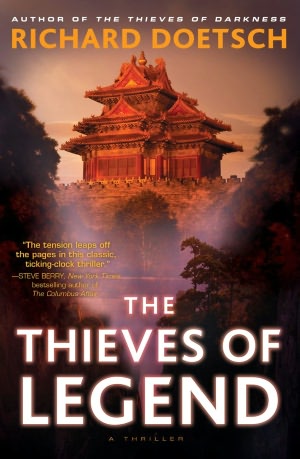
New from Atria Books: The Thieves of Legend: A Thriller by Richard Doetsch.

About the book, from the publisher:

In a world of dark and light, where East meets West, a horrific act of violence propels former thief Michael St. Pierre into a mystery that began five hundred years ago....

In Richard Doetsch's next unforgettable Thieves thriller, Michael and his ex-girlfriend KC Ryan have been blackmailed by a U.S. Army colonel. They are to travel to opposite ends of China, and each is responsible for stealing a piece of an ancient puzzle: a diary and a compass. With their lives dependent on each other’s success, they must face off against the complex underworld of the Chinese triads, a twisted female assassin, and a madman whose only desire is to possess the secrets held within the pages of the diary—knowledge that would give him enormous power and lead to the downfall of nations.

Moving from the glittering casinos of Macau to its dark and dangerous backstreets; from the palace at the heart of China’s Forbidden City to the medieval castles of Spain; from the seaside mansions along the Amalfi Coast to an uncharted Pacific island, Michael is in a race against time. He has less than five days to uncover a five-hundred-year-old mystery—and to save KC from certain death.
Learn more about the book and author at Richard Doetsch's website and blog.

The Page 69 Test: Richard Doetsch's Half-Past Dawn.

Wednesday, November 7, 2012

"Caesar in the USA"

New from the University of California Press: Caesar in the USA by Maria Wyke.

About the book, from the publisher:

The figure of Julius Caesar has loomed large in the United States since its very beginning, admired and evoked as a gateway to knowledge of politics, war, and even national life. In this lively and perceptive book, the first to examine Caesar's place in modern American culture, Maria Wyke investigates how his use has intensified in periods of political crisis, when the occurrence of assassination, war, dictatorship, totalitarianism or empire appears to give him fresh relevance. Her fascinating discussion shows how—from the Latin classroom to the Shakespearean stage, from cinema, television and the comic book to the internet—Caesar is mobilized in the U.S. as a resource for acculturation into the American present, as a prediction of America’s future, or as a mode of commercial profit and great entertainment.
Read Chapter 1 of Caesar in the USA.

The Page 99 Test: Maria Wyke's Caesar: A Life in Western Culture.

"The Buzzard Table"

New from Grand Central Publishing: The Buzzard Table by Margaret Maron.

About the book, from the publisher:

Judge Deborah Knott and Sheriff's Deputy Dwight Bryant are back home in Colleton County with all their family and courthouse regulars. But there are a few new faces as well. Lt. Sigrid Herald and her mother, Anne, a well-known photographer, are down from New York to visit Anne's ailing mother, Mrs. Lattimore. When the group gathers for dinner at Mrs. Lattimore's Victorian home, they meet the enigmatic Martin Crawford, an ornithologist who claims to be researching a new book on Southern vultures. More importantly, he's Mrs. Lattimore's long-lost nephew, and Sigrid and Anne's English cousin. With her health in decline, Mrs. Lattimore wants to make amends with her family--something Deborah can understand as she too is working to strengthen her relationship with her stepson, Cal. But for all his mysterious charm, Anne can't shake the feeling that there is something familiar about Martin...something he doesn't want Anne or anyone else to discover. When a murderer strikes, Deborah, Dwight, and Sigrid will once again work together to solve the crime and uncover long-buried Lattimore family secrets.
Learn more about the book and author at Margaret Maron's website.

The Page 69 Test: Three-Day Town.

Tuesday, November 6, 2012

"The Forgotten"

New from Grand Central Publishing: The Forgotten by David Baldacci.

About the book, from the publisher:

In Paradise, nothing is what it seems...

THE FORGOTTEN

Army Special Agent John Puller is the best there is. A combat veteran, Puller is the man the U.S. Army relies on to investigate the toughest crimes facing the nation. Now he has a new case-but this time, the crime is personal: His aunt has been found dead in Paradise, Florida.

A picture-perfect town on Florida's Gulf Coast, Paradise thrives on the wealthy tourists and retirees drawn to its gorgeous weather and beaches. The local police have ruled his aunt's death an unfortunate, tragic accident. But just before she died, she mailed a letter to Puller's father, telling him that beneath its beautiful veneer, Paradise is not all it seems to be.

What Puller finds convinces him that his aunt's death was no accident . . . and that the palm trees and sandy beaches of Paradise may hide a conspiracy so shocking that some will go to unthinkable lengths to make sure the truth is never revealed.

"Walking Sideways"

New from Cornell University Press: Walking Sideways: The Remarkable World of Crabs by Judith S. Weis.

About the book, from the publisher:

The world's nearly 7,000 species of crabs are immediately recognizable by their claws, sideways movement, stalked eyes, and thick outer shells. These common crustaceans are found internationally, thriving in various habitats from the edge of the sea to the depths of the ocean, in fresh water or on land. Despite having the same basic body type as decapod crustaceans—true crabs have heavy exoskeletons and ten limbs with front pincer claws—crabs come in an enormous variety of shapes and sizes, from the near microscopic to the giant Japanese spider crab.

In Walking Sideways, Judith S. Weis provides an engaging and informative tour of the remarkable world of crabs, highlighting their unique biology and natural history. She introduces us to recently discovered crabs such as the Yeti crab found in deep sea vents, explains what scientists are learning about blue and hermit crabs commonly found at the shore, and gives us insight into the lifecycles of the king and Dungeness crabs typically seen only on dinner plates. Among the topics Weis covers are the evolution and classification of crabs, their habitats, unique adaptations to water and land, reproduction and development, behavior, ecology, and threats, including up-to-date research.

Crabs are of special interest to biologists for their communication behaviors, sexual dimorphism, and use of chemical stimuli and touch receptors, and Weis explains the importance of new scientific discoveries. In addition to the traditional ten-legged crabs, the book also treats those that appear eight-legged, including hermit crabs, king crabs, and sand crabs. Sidebars address topics of special interest, such as the relationship of lobsters to crabs and medical uses of compounds derived from horseshoe crabs (which aren't really crabs).

While Weis emphasizes conservation and the threats that crabs face, she also addresses the use of crabs as food (detailing how crabs are caught and cooked) and their commercial value from fisheries and aquaculture. She highlights other interactions between crabs and people, including keeping hermit crabs as pets or studying marine species in the laboratory and field. Reminding us of characters such as The Little Mermaid’s Sebastian and Sherman Lagoon’s Hawthorne, she also surveys the role of crabs in literature (for both children and adults), film, and television, as well in mythology and astrology. With illustrations that offer delightful visual evidence of crab diversity and their unique behaviors, Walking Sideways will appeal to anyone who has encountered these fascinating animals on the beach, at an aquarium, or in the kitchen.

Monday, November 5, 2012

"Truth or Beauty"

New from Yale University Press: Truth or Beauty: Science and the Quest for Order by David Orrell.

About the book, from the publisher:

In this sweeping book, applied mathematician and popular author David Orrell questions the promises and pitfalls of associating beauty with truth, showing how ideas of mathematical elegance have inspired—and have sometimes misled—scientists attempting to understand nature.

Orrell shows how the ancient Greeks constructed a concept of the world based on musical harmony; later thinkers replaced this model with a program, based on Newton’s “rational mechanics,” to reduce the universe to a few simple equations. He then turns to current physical theories, such as supersymmetric string theory—again influenced by deep aesthetic principles. The book sheds new light on historical investigations and also recent research, including the examinations ongoing at the Large Hadron Collider. Finally, broadening his discussion to other fields of research, including economics, architecture, and health, Orrell questions whether these aesthetic principles reflect an accurate way to explain and understand the structure of our world.
Visit David Orrell's website.

"The Right Hand"

New from Little, Brown & Company: The Right Hand by Derek Haas.

About the book, from the publisher:

Meet Austin Clay, the CIA's best-kept secret.

There has always been a need in the spy game for operations outside the realm of legality-covert missions so black no one in the American government, and almost no one in intelligence itself, is aware of their existence. The left hand can't know what the right hand is doing.

Austin Clay is that right hand, executing missions that would be disavowed by his own government were he ever to be compromised. His team consists of only his trusted handler and himself. His missions are among the most important and dangerous in U.S. history.

Clay is sent to track down a missing American operative, a man who was captured outside of Moscow, in the Russian countryside. Soon he discovers the missing officer is only the beginning of the mission, and finds himself protecting a desperate woman who believes a mole has penetrated the top levels of the U.S. government, throwing the international balance of power into jeopardy.

With blistering pace, international intrigue, and a high-stakes plot that spans continents, THE RIGHT HAND introduces a new hero, from the novelist whose work the New York Times Book Review has proclaimed "devastatingly cool."
Visit Derek Haas's website.

My Book, The Movie: Dark Men.

Writers Read: Derek Haas.

The Page 69 Test: Dark Men.

Sunday, November 4, 2012

"The Patriarch"

New from Penguin: The Patriarch: The Remarkable Life and Turbulent Times of Joseph P. Kennedy by David Nasaw.

About the book, from the publisher:

In this magisterial new work The Patriarch, the celebrated historian David Nasaw tells the full story of Joseph P. Kennedy, the founder of the twentieth century’s most famous political dynasty. Nasaw—the only biographer granted unrestricted access to the Joseph P. Kennedy papers in the John F. Kennedy Presidential Library—tracks Kennedy’s astonishing passage from East Boston outsider to supreme Washington insider. Kennedy’s seemingly limitless ambition drove his career to the pinnacles of success as a banker, World War I shipyard manager, Hollywood studio head, broker, Wall Street operator, New Deal presidential adviser, and founding chair¬man of the Securities and Exchange Commission. His astounding fall from grace into ignominy did not come until the years leading up to and following America’s entry into the Second World War, when the antiwar position he took as the first Irish American ambassador to London made him the subject of White House ire and popular distaste.

The Patriarch is a story not only of one of the twentieth century’s wealthiest and most powerful Americans, but also of the family he raised and the children who completed the journey he had begun. Of the many roles Kennedy held, that of father was most dear to him. The tragedies that befell his family marked his final years with unspeakable suffering.

The Patriarch looks beyond the popularly held portrait of Kennedy to answer the many questions about his life, times, and legacy that have continued to haunt the historical record. Was Joseph P. Kennedy an appeaser and isolationist, an anti-Semite and a Nazi sympathizer, a stock swindler, a bootlegger, and a colleague of mobsters? What was the nature of his relationship with his wife, Rose? Why did he have his daughter Rosemary lobotomized? Why did he oppose the Truman Doctrine, the Marshall Plan, the Korean War, and American assistance to the French in Vietnam? What was his relationship to J. Edgar Hoover and the FBI? Did he push his second son into politics and then buy his elections for him?

In this pioneering biography, Nasaw draws on never-before-published materials from archives on three continents and interviews with Kennedy fam¬ily members and friends to tell the life story of a man who participated in the major events of his times: the booms and busts, the Depression and the New Deal, two world wars and a cold war, and the birth of the New Frontier. In studying Kennedy’s life, we relive with him the history of the American Century.
See Nasaw's five best books about the Kennedys.

The Page 69 Test: David Nasaw's Andrew Carnegie.

"Dead Asleep"

New from Harper: Dead Asleep by Jamie Freveletti.

About the book, from the publisher:

The devil is awake in paradise...

Biochemist Emma Caldridge comes to a remote tropical island in the Caribbean in search of minerals believed to reverse the aging process. What she finds instead are the bloody remnants of a bizarre religious ritual. And here, where the local people speak in whispers about sea monsters, ancient voodoo curses, and rampaging evil, she discovers something far more real ... and more terrifying.

One by one, the island’s innocent inhabitants are descending into a paralyzing sleep of the dead—victims of a long-dormant, terrifying, and incurable pandemic that could once again wreak unimaginable havoc if it escapes from the island to spread like wildfire across the globe. Trapped by a global quarantine, Emma must break through the fear and superstition to get to the truth and stop the real evil, before she herself succumbs to the death sleep ... along with millions of others.

Because the evil here has an all-too-human face ... and the deadly ingredients of the apocalypse are suddenly for sale to the highest bidder.
Learn more about the book and author at Jamie Freveletti's website.

The Page 69 Test: Running from the Devil.

The Page 69 Test: The Ninth Day.