Friday, July 22, 2022

"The Lost Kings"

New from Anchor: The Lost Kings: A Novel by Tyrell Johnson.

About the book, from the publisher:

A riveting psychological thriller with a killer twist about a woman forced to confront the darkest moment in her childhood in order to move on from her past and open her heart to love.

Twins Jeanie and Jamie King are inseparable. Stuck in a cabin in rural Washington with their alcoholic father, they cling to one another for safety and companionship. Until one night, when their father comes home covered in blood. The next day, he’s gone . . . and so is Jamie. Jeanie’s whole world is turned upside down. Not only has she lost her beloved brother, but with no family left in Washington, she is ripped from everything she knows, including Maddox, the boy she could be learning to love.

Twenty years later, Jeanie is in England. She keeps her demons at bay by drinking too much, sleeping with a married man, and speaking to a therapist she doesn’t respect. But her old life catches up to her when Maddox reappears, claiming to have tracked down her dad. Stunned, Jeanie must decide whether to continue running from her past or to confront her father and finally find out what really happened that night, where her brother is, and why she was the one left behind.

At once a propulsive, heart-pounding mystery and an affecting exploration of love and the familial ties that bind us, The Lost Kings will transport, move, and shock you.
Visit Tyrell Johnson's website.

Writers Read: Tyrell Johnson (January 2018).

--Marshal Zeringue

"The Five-Million-Year Odyssey"

New from Princeton University Press: The Five-Million-Year Odyssey: The Human Journey from Ape to Agriculture by Peter Bellwood.

About the book, from the publisher:

Over the course of five million years, our primate ancestors evolved from a modest population of sub-Saharan apes into the globally dominant species Homo sapiens. Along the way, humans became incredibly diverse in appearance, language, and culture. How did all of this happen? In The Five-Million-Year Odyssey, Peter Bellwood synthesizes research from archaeology, biology, anthropology, and linguistics to immerse us in the saga of human evolution, from the earliest traces of our hominin forebears in Africa, through waves of human expansion across the continents, and to the rise of agriculture and explosive demographic growth around the world.

Bellwood presents our modern diversity as a product of both evolution, which led to the emergence of the genus Homo approximately 2.5 million years ago, and migration, which carried humans into new environments. He introduces us to the ancient hominins—including the australopithecines, Homo erectus, the Neanderthals, and others—before turning to the appearance of Homo sapiens circa 300,000 years ago and subsequent human movement into Eurasia, Australia, and the Americas. Bellwood then explores the invention of agriculture, which enabled farmers to disperse to new territories over the last 10,000 years, facilitating the spread of language families and cultural practices. The outcome is now apparent in our vast array of contemporary ethnicities, linguistic systems, and customs.

The fascinating origin story of our varied human existence, The Five-Million-Year Odyssey underscores the importance of recognizing our shared genetic heritage to appreciate what makes us so diverse.
--Marshal Zeringue

"The Codebreaker's Secret"

New from MIRA: The Codebreaker's Secret: A WWII Novel by Sara Ackerman.

About the book, from the publisher:

A brilliant female codebreaker. An “unbreakable” Japanese naval code. A pilot on a top-secret mission that could change the course of WWII. The Codebreaker's Secret is a dazzling story of love and intrigue set during America’s darkest hour.

1943. As war in the Pacific rages on, Isabel Cooper and her codebreaker colleagues huddle in “the dungeon” at Station HYPO in Pearl Harbor, deciphering secrets plucked from the airwaves in a race to bring down the enemy. Isabel has only one wish: to avenge her brother’s death. But she soon finds life has other plans when she meets his best friend, a hotshot pilot with secrets of his own.

1965. Fledgling journalist Lu Freitas comes home to Hawai'i to cover the grand opening of the glamorous Mauna Kea Beach Hotel, Rockefeller's newest and grandest project. When a high-profile guest goes missing, Lu forms an unlikely alliance with an intimidating veteran photographer to unravel the mystery. The two make a shocking discovery that stirs up memories and uncovers an explosive secret from the war days. A secret that only a codebreaker can crack.
Visit Sara Ackerman's website.

--Marshal Zeringue

"Ploughshares and Swords"

New from Cornell University Press: Ploughshares and Swords: India's Nuclear Program in the Global Cold War by Jayita Sarkar.

About the book, from the publisher:

India's nuclear program is often misunderstood as an inward-looking endeavor of secretive technocrats. In Ploughshares and Swords, Jayita Sarkar challenges this received wisdom, narrating a global story of India's nuclear program during its first forty years. The book foregrounds the program's civilian and military features by probing its close relationship with the space program. Through nuclear and space technologies, India's leaders served the technopolitical aims of economic modernity and the geopolitical goals of deterring adversaries.

The politically savvy, transnationally connected scientists and engineers who steered the program obtained technologies, materials, and information through a variety of state and nonstate actors from Europe and North America, including both superpowers. They thus maneuvered around Cold War politics and the choke points of the nonproliferation regime. Hyperdiversification increased choices for the leaders of the nuclear program but reduced democratic accountability at home. The nuclear program became a consensus-enforcing device in the name of the nation.

Ploughshares and Swords is a provocative new history with global implications. It shows how geopolitical and technopolitical visions influence decisions about the nation after decolonization.
Visit Jayita Sarkar's website.

--Marshal Zeringue

Thursday, July 21, 2022

"Mademoiselle Revolution"

New from Berkley: Mademoiselle Revolution by Zoe Sivak.

About the book, from the publisher:

A powerful, engrossing story of a biracial heiress who escapes to Paris when the Haitian Revolution burns across her island home. But as she works her way into the inner circle of Robespierre and his mistress, she learns that not even oceans can stop the flames of revolution.

Sylvie de Rosiers, as the daughter of a rich planter and an enslaved woman, enjoys the comforts of a lady in 1791 Saint-Domingue society. But while she was born to privilege, she was never fully accepted by island elites. After a violent rebellion begins the Haitian Revolution, Sylvie and her brother leave their family and old lives behind to flee unwittingly into another uprising—in austere and radical Paris. Sylvie quickly becomes enamored with the aims of the Revolution, as well as with the revolutionaries themselves—most notably Maximilien Robespierre and his mistress, Cornélie Duplay.

As a rising leader and abolitionist, Robespierre sees an opportunity to exploit Sylvie’s race and abandonment of her aristocratic roots as an example of his ideals, while the strong-willed Cornélie offers Sylvie safe harbor and guidance in free thought. Sylvie battles with her past complicity in a slave society and her future within this new world order as she finds herself increasingly torn between Robespierre’s ideology and Cornélie’s love.
Visit Zoe Sivak's website.

--Marshal Zeringue

"Making Space for Justice"

New from Columbia University Press: Making Space for Justice: Social Movements, Collective Imagination, and Political Hope by Michele Moody-Adams.

About the book, from the publisher:

From nineteenth-century abolitionism to Black Lives Matter today, progressive social movements have been at the forefront of social change. Yet it is seldom recognized that such movements have not only engaged in political action but also posed crucial philosophical questions about the meaning of justice and about how the demands of justice can be met.

Michele Moody-Adams argues that anyone who is concerned with the theory or the practice of justice—or both—must ask what can be learned from social movements. Drawing on a range of compelling examples, she explores what they have shown about the nature of justice as well as what it takes to create space for justice in the world. Moody-Adams considers progressive social movements as wellsprings of moral inquiry and as agents of social change, drawing out key philosophical and practical principles. Social justice demands humane regard for others, combining compassionate concern and robust respect. Successful movements have drawn on the transformative power of imagination, strengthening the motivation to pursue justice and to create the political institutions and social policies that can sustain it by inspiring political hope.

Making Space for Justice contends that the insights arising from social movements are critical to bridging the gap between discerning theory and effective practice—and should be transformative for political thought as well as for political activism.
Visit Michele Moody-Adams's website.

--Marshal Zeringue

"The Devouring Wolf"

New from Razorbill: The Devouring Wolf by Natalie C. Parker.

About the book, from the publisher:

Little wolf, little wolf, here I come.

It’s the eve of the first full moon of summer and twelve-year-old Riley Callahan is ready to turn into a wolf. Nothing can ruin her mood: not her little brother Milo’s teasing, not Mama N’s smoth-ering, and not even Mama C’s absence from their pack’s ceremony. But then the unthink-able happens—something that violates every rule of wolf magic—Riley and four other kids don’t shift.

Riley is left with questions that even the pack leaders don’t have answers to. And to make matters far worse, it appears something was awoken in the woods that same night.

The Devouring Wolf.

The elders tell the tale of the Devouring Wolf to scare young pups into obedience. It’s a terrifying campfire story for fledging wolves, an old legend of a giant creature who consumes the magic inside young werewolves. But to Riley, the Devouring Wolf is more than lore: it’s real and it’s after her and her friends.
Visit Natalie C. Parker's website.

The Page 69 Test: Beware the Wild.

My Book, The Movie: Beware the Wild.

--Marshal Zeringue

"Formidable: American Women and the Fight for Equality"

New from Pegasus Books: Formidable: American Women and the Fight for Equality: 1920-2020 by Elisabeth Griffith.

About the book, from the publisher:

The Nineteenth Amendment was an incomplete victory. Black and white women fought hard for voting rights and doubled the number of eligible voters, but the amendment did not enfranchise all women, or even protect the rights of those women who could vote. A century later, women are still grappling with how to use the vote and their political power to expand civil rights, confront racial violence, improve maternal health, advance educational and employment opportunities, and secure reproductive rights.

Formidable chronicles the efforts of white and Black women to advance sometimes competing causes. Black women wanted the rights enjoyed by whites. They wanted to protect their communities from racial violence and discrimination. Theirs was not only a women’s movement. White women wanted to be equal to white men. They sought equal legal rights, political power, safeguards for working women and immigrants, and an end to confining social structures. There were also many white women who opposed any advance for any women.

In this riveting narrative, Dr. Elisabeth Griffith integrates the fight by white and Black women to achieve equality. Previously their parallel struggles for social justice have been presented separately—as white or Black topics—or covered narrowly, through only certain individuals, decades, or incidents. Formidable provides a sweeping, century-long perspective, and an expansive cast of change agents. From feminists and civil rights activists to politicians and social justice advocates, from working class women to mothers and homemakers, from radicals and conservatives to those who were offended by feminism, threatened by social change, or convinced of white supremacy, the diversity of the women’s movement mirrors America.

After that landmark victory in 1920, suffragists had a sense of optimism, declaring, “Now we can begin!” By 2020, a new generation knew how hard the fight for incremental change was; they would have to begin again. Both engaging and outraging, Formidable will propel readers to continue their foremothers’ fights to achieve equality for all.
Visit Elisabeth Griffith's website.

--Marshal Zeringue

Wednesday, July 20, 2022

"Dirt Creek"

New from Flatiron Books: Dirt Creek: A Novel by Hayley Scrivenor.

About the book, from the publisher:

In Hayley Scrivenor's Dirt Creek, a small-town debut mystery described as The Dry meets Everything I Never Told You, a girl goes missing and a community falls apart and comes together.

When twelve-year-old Esther disappears on the way home from school in a small town in rural Australia, the community is thrown into a maelstrom of suspicion and grief. As Detective Sergeant Sarah Michaels arrives in town during the hottest spring in decades and begins her investigation, Esther’s tenacious best friend, Ronnie, is determined to find Esther and bring her home.

When schoolfriend Lewis tells Ronnie that he saw Esther with a strange man at the creek the afternoon she went missing, Ronnie feels she is one step closer to finding her. But why is Lewis refusing to speak to the police? And who else is lying about how much they know about what has happened to Esther?

Punctuated by a Greek chorus, which gives voice to the remaining children of the small, dying town, this novel explores the ties that bind, what we try and leave behind us, and what we can never outrun, while never losing sight of the question of what happened to Esther, and what her loss does to a whole town.
Visit Hayley Scrivenor's website.

--Marshal Zeringue

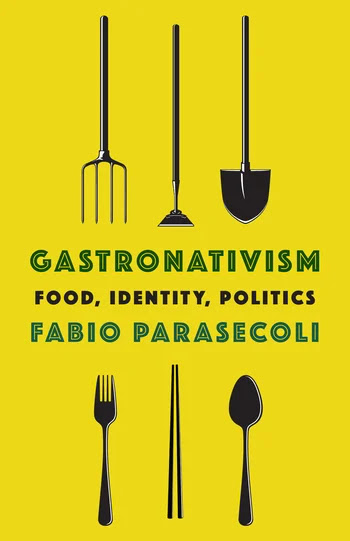
"Gastronativism"

New from Columbia University Press: Gastronativism: Food, Identity, Politics by Fabio Parasecoli.

About the book, from the publisher:

The Italian political right is outraged by halal tortellini and a pork-free lasagna served at the Vatican. In India, Hindu fundamentalists organize attacks on Muslims who sell beef. European anti-immigrant politicians denounce couscous and kebabs. In an era of nationalist and exclusionary movements, food has become a potent symbol of identity. Why has eating become so politically charged—and can the emotions surrounding food be redirected in a healthier direction?

Fabio Parasecoli identifies and defines the phenomenon of “gastronativism,” the ideological use of food to advance ideas about who belongs to a community and who does not. As globalization and neoliberalism have transformed food systems, people have responded by seeking to return to their roots. Many have embraced local ingredients and notions of cultural heritage, but this impulse can play into the hands of nationalist and xenophobic political projects. Such movements draw on the strong emotions connected with eating to stoke resentment and contempt for other people and cultures.

Parasecoli emphasizes that gastronativism is a worldwide phenomenon, even as it often purports to oppose local aspects and consequences of globalization. He also explores how to channel pride in culinary traditions toward resisting transnational corporations, uplifting marginalized and oppressed groups, and assisting people left behind by globalization. Featuring a wide array of examples from all over the world, Gastronativism is a timely, incisive, and lively analysis of how and why food has become a powerful political tool.
Visit Fabio Parasecoli's website.

--Marshal Zeringue