Friday, March 24, 2023

"House of Cotton"

New from Flatiron Books: House of Cotton: A Novel by Monica Brashears.

About the book, from the publisher:

A stunning, contemporary Black southern gothic novel about what it means to be a poor woman in the God- fearing south. Perfect for readers of The Other Black Girl and Luster

Magnolia Brown is nineteen years old, broke, and effectively an orphan. She feels stuck and haunted: by her overdrawn bank account, her predatory landlord, and the ghost of her late grandmother Mama Brown.

One night, while working at her dead-end gas station job, a mysterious, slick stranger named Cotton walks in and offers to turn Magnolia’s luck around with a lucrative “modeling” job at his family’s funeral home. She accepts. But despite things looking up, Magnolia’s problems fatten along with her wallet. When Cotton’s requests become increasingly weird, Magnolia discovers there’s a lot more at stake than just her rent.

Sharp as a belted knife, this sly social commentary cuts straight to the bone. House of Cotton will keep you mesmerized until the very last page.
Visit Monica Brashears's website and follow her on Twitter.

--Marshal Zeringue

"Monitoring American Federalism"

New from Cambridge University Press: Monitoring American Federalism: The History of State Legislative Resistance by Christian G. Fritz.

About the book, from the publisher:

Monitoring American Federalism examines some of the nation's most significant controversies in which state legislatures have attempted to be active partners in the process of constitutional decision-making. Christian G. Fritz looks at interposition, which is the practice of states opposing federal government decisions that were deemed unconstitutional. Interposition became a much-used constitutional tool to monitor the federal government and organize resistance, beginning with the Constitution's ratification and continuing through the present affecting issues including gun control, immigration and health care. Though the use of interposition was largely abandoned because of its association with nullification and the Civil War, recent interest reminds us that the federal government cannot run roughshod over states, and that states lack any legitimate power to nullify federal laws. Insightful and comprehensive, this appraisal of interposition breaks new ground in American political and constitutional history, and can help us preserve our constitutional system and democracy.
The Page 99 Test: American Sovereigns.

--Marshal Zeringue

Thursday, March 23, 2023

"Halfway to You"

New from Lake Union Publishing: Halfway to You: A Novel by Jennifer Gold.

About the book, from the publisher:

An ambitious podcaster and her reclusive interviewee embark on a life-altering journey to uncover long-lost truths in this immersive story about love, travel, and family secrets.

Forty years ago, aspiring writer Ann Fawkes left the United States for a Mediterranean adventure that opened her heart to travel and love. After a chance encounter propelled her into the publishing world, she released her first novel, an instant bestseller―and the last book she ever wrote.

Now, Ann lives a reclusive life in the San Juan Islands, hiding from the public and its probing questions. But when podcaster Maggie Whitaker convinces Ann to sit for an interview, Ann agrees on one condition: Maggie must keep her story off the record.

Determined to change Ann’s mind before she loses her job, Maggie agrees. But as she learns about Ann’s life―particularly the love affair that inspired her novel and the decisions she made in its wake―Maggie realizes Ann’s story intersects with her own in shocking, life-changing ways.

A sweeping, heart-wrenching novel that spans decades and continents, Halfway to You explores the distances we create between ourselves and the ones we love most and what it takes to finally bridge them.
Visit Jennifer Gold's website.

--Marshal Zeringue

"Subcontractors of Guilt"

New from Stanford University Press: Subcontractors of Guilt: Holocaust Memory and Muslim Belonging in Postwar Germany by Esra Özyürek.

About the book, from the publisher:

At the turn of the millennium, Middle Eastern and Muslim Germans had rather unexpectedly become central to the country's Holocaust memory culture—not as welcome participants, but as targets for re-education and reform. Since then, Turkish- and Arab-Germans have been considered as the prime obstacles to German national reconciliation with its Nazi past, a status shared to a lesser degree by Germans from the formerly socialist East Germany. It is for this reason that the German government, German NGOs, and Muslim minority groups have begun to design Holocaust education and anti-Semitism prevention programs specifically tailored for Muslim immigrants and refugees, so that they, too, can learn the lessons of the Holocaust and embrace Germany's most important postwar democratic political values. Based on ethnographic research conducted over a decade, Subcontractors of Guilt explores when, how, and why Muslim Germans have moved to the center of Holocaust memory discussions. Esra Özyürek argues that German society "subcontracts" guilt of the Holocaust to new minority immigrant arrivals, with the false promise of this process leading to inclusion into the German social contract and equality with other members of postwar German society. By focusing on the recently formed but already sizable sector of Muslim-only anti-Semitism and Holocaust education programs, this book explores the paradoxes of postwar German national identity.
The Page 99 Test: Being German, Becoming Muslim.

--Marshal Zeringue

"The Society of Shame"

New from Anchor: The Society of Shame by Jane Roper.

About the book, from the publisher:

In this timely and witty combination of So You’ve Been Publicly Shamed and Where’d You Go, Bernadette? a viral photo of a politician’s wife’s “feminine hygiene malfunction” catapults her to unwanted fame in a story that’s both a satire of social media stardom and internet activism, and a tender mother-daughter tale.

Kathleen Held’s life is turned upside down when she arrives home to find her house on fire and her husband on the front lawn in his underwear. But the scandal that emerges is not that Bill, who’s running for Senate, is having a painfully cliched affair with one of his young staffers: it’s that the eyewitness photographing the scene accidentally captures a period stain on the back of Kathleen’s pants.

Overnight, Kathleen finds herself the unwitting figurehead for a social media-centered women’s right movement, #YesWeBleed. Humiliated, Kathleen desperately seeks a way to hide from the spotlight. But when she stumbles upon the Society of Shame—led by the infamous author Danica Bellevue—Kathleen finds herself part of a group who are all working to change their lives after their own scandals. Using the teachings of the society, Kathleen channels her newfound fame as a means to reap the benefits of her humiliation and reclaim herself. But as she ascends to celebrity status, Kathleen’s growing obsession with maintaining her popularity online threatens her most important relationship IRL: that with her budding activist daughter, Aggie.

Hilarious and heartfelt, The Society of Shame is a pitch-perfect romp through politics and the perils of being “extremely online”—without losing your sanity or your true self.
Visit Jane Roper's website.

--Marshal Zeringue

"Living Accountably"

New from Oxford University Press: Living Accountably: Accountability as a Virtue by C. Stephen Evans.

About the book, from the publisher:

In contemporary culture, accountability is usually understood in terms of holding people who have done something wrong accountable for their actions. As such, it is virtually synonymous with punishing someone. Living Accountably argues that accountability should also be understood as a significant, forward-looking virtue, an excellence possessed by those who willingly embrace being accountable to those who have proper standing, when that standing is exercised appropriately. Those who have this virtue are people who strive to live accountably. The book gives a fine-grained description of the virtue and how it is exercised, including an account of the motivational profile of the one who has the virtue. It examines the relation of accountability to other virtues, such as honesty and humility, as well as opposing vices, such as self-deception, arrogance, and servility. Though the virtue of accountability is compatible with individual autonomy, recognizing the importance of the virtue does justice to the social character of human persons. C. Stephen Evans also explores the history of this virtue in other cultures and historical eras, providing evidence that the virtue is widely recognized, even if it is somewhat eclipsed in modern western societies.

Accountability is also a virtue that connects ethical life with religious life for many people, since it is common for people to have a sense that they are accountable in a global way for how they live their lives. Living Accountably explores the question as to whether global accountability can be understood in a purely secular way, as accountability to other humans, or whether it must be understood as accountability to God, or some other transcendent reality.
Visit C. Stephen Evans's website.

--Marshal Zeringue

Wednesday, March 22, 2023

"Camp Zero"

New from Atria/Simon & Schuster: Camp Zero: A Novel by Michelle Min Sterling.

About the book, from the publisher:

In a near-future northern settlement, a handful of climate change survivors find their fates intertwined in this mesmerizing and transportive novel in the vein of Station Eleven and The Power.

In the far north of Canada sits Camp Zero, an American building project hiding many secrets.

Desperate to help her climate-displaced Korean immigrant mother, Rose agrees to travel to Camp Zero and spy on its architect in exchange for housing. She arrives at the same time as another newcomer, a college professor named Grant who is determined to flee his wealthy family’s dark legacy. Gradually, they realize that there is more to the architect than previously thought, and a disturbing mystery lurks beneath the surface of the camp. At the same time, rumors abound of an elite group of women soldiers living and working at a nearby Cold War-era climate research station. What are they doing there? And who is leading them?

An electrifying page-turner where nothing is as it seems, Camp Zero cleverly explores how the intersection of gender, class, and migration will impact who and what will survive in a warming world.
Visit Michelle Min Sterling's website.

--Marshal Zeringue

"Ending Epidemics"

New from the MIT Press: Ending Epidemics: A History of Escape from Contagion by Richard Conniff.

About the book, from the publisher:

How scientists saved humanity from the deadliest infectious diseases—and what we can do to prepare ourselves for future epidemics.

After the unprecedented events of the COVID-19 pandemic, it may be hard to imagine a time not so long ago when deadly diseases were a routine part of life. It is harder still to fathom that the best medical thinking at that time blamed these diseases on noxious miasmas, bodily humors, and divine dyspepsia. This all began to change on a day in April 1676, when a little-known Dutch merchant described bacteria for the first time. Beginning on that day in Delft and ending on the day in 1978 when the smallpox virus claimed its last known victim, Ending Epidemics explains how we came to understand and prevent many of our worst infectious diseases—and double average life expectancy.

Ending Epidemics tells the story behind “the mortality revolution,” the dramatic transformation not just in our longevity, but in the character of childhood, family life, and human society. Richard Conniff recounts the moments of inspiration and innovation, decades of dogged persistence, and, of course, periods of terrible suffering that stir individuals, institutions, and governments to act in the name of public health. Stars of medical science feature in this drama, but lesser-known figures also play a critical role. And while the history of germ theory is central to this story, Ending Epidemics also describes the importance of everything from sanitation improvements and the discovery of antibiotics to the development of the microscope and the syringe—technologies we now take for granted.
Visit Richard Conniff's website.

--Marshal Zeringue

"The Lost Wife"

New from Knopf: The Lost Wife: A Novel by Susanna Moore.

About the book, from the publisher:

From one of our most compelling and sensual writers comes a searing, immersive novel about a seminal and shameful moment in America’s conquest of the West. Drawing partly from a true story, it brings to life a devastating Native American revolt and the woman caught in the middle of the conflict.

In the summer of 1855, Sarah Brinton abandons her husband and child to make the long and difficult journey from Rhode Island to Minnesota Territory, where she plans to reunite with a childhood friend. When she arrives at a small frontier post on the edge of the prairie without family or friends and with no prospect of work or money, she quickly remarries and has two children. Anticipating unease and hardship at the Indian Agency, where her husband Dr. John Brinton is the new resident physician, Sarah instead finds acceptance and kinship among the Sioux women at a nearby reservation.

The Sioux tribes, however, are wary of the white settlers and resent the rampant theft of their land. Promised payments by the federal government are never made, and starvation and disease soon begin to decimate their community. Tragically and inevitably, this leads to the Sioux Uprising of 1862. During the conflict, Sarah and her children are abducted by the Sioux, who protect her, but because she sympathizes with her captors, Sarah becomes an outcast to the white settlers. In the end, she is lost to both worlds.

Intimate and raw, The Lost Wife is a brilliantly subversive tale of the conquest of the American West.
Learn more about the book and author at Susanna Moore's website.

The Page 69 Test: The Life of Objects.

Writers Read: Susanna Moore (October 2012).

The Page 99 Test: Miss Aluminum.

--Marshal Zeringue

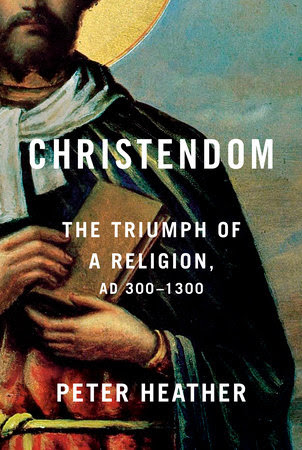
"Christendom: The Triumph of a Religion, AD 300-1300"

New from Knopf: Christendom: The Triumph of a Religion, AD 300-1300 by Peter Heather.

About the book, from the publisher:

A major reinterpretation of the religious superstate that came to define both Europe and Christianity itself, by one of our foremost medieval historians.

In the fourth century AD, a new faith grew out of Palestine, overwhelming the paganism of Rome and resoundingly defeating a host of other rival belief systems. Almost a thousand years later, all of Europe was controlled by Christian rulers, and the religion, ingrained within culture and society, exercised a monolithic hold over its population. But how did a small sect of isolated and intensely committed congregations become a mass movement centrally directed from Rome? As Peter Heather shows in this illuminating new history, there was nothing inevitable about Christendom's rise and eventual dominance.

From Constantine the Great's pivotal conversion to Christianity to the crisis that followed the collapse of the Roman empire—which left the religion teetering on the edge of extinction—to the astonishing revolution of the eleventh century and beyond, out of which the Papacy emerged as the head of a vast international corporation, Heather traces Christendom's chameleonlike capacity for self-reinvention, as it not only defined a fledgling religion but transformed it into an institution that wielded effective authority across virtually all of the disparate peoples of medieval Europe.

Authoritative, vivid, and filled with new insights, this is an unparalleled history of early Christianity.
--Marshal Zeringue