Sunday, March 5, 2023

"The Dog of the North"

New from Penguin Press: The Dog of the North: A Novel by Elizabeth McKenzie.

About the book, from the publisher:

From the National Book Award–longlisted author of The Portable Veblen

*One of Kirkus’s Top 10 Novels for 2023*

Penny Rush has problems. Her marriage is over; she’s quit her job. Her mother and stepfather went missing in the Australian outback five years ago; her mentally unbalanced father provokes her; her grandmother Dr. Pincer keeps experiments in the refrigerator and something worse in the woodshed. But Penny is a virtuoso at what’s possible when all else fails.

Elizabeth McKenzie, beloved novelist of California and its idiosyncrasies, follows Penny on her quest for a fresh start. There will be a road trip in the Dog of the North, an old van with gingham curtains, a piñata, and stiff brakes. There will be injury and peril. There will be a dog named Kweecoats and two brothers who may share a toupee. There will be questions: Why is a detective investigating her grandmother, and what is “the scintillator”? And can Penny recognize a good thing when it finally comes her way?

This slyly humorous, thoroughly winsome novel finds the purpose in life’s curveballs, insisting that even when we are painfully warped by those we love most, we can be brought closer to our truest selves.
Learn more about the author and her work at Elizabeth McKenzie's website.

The Page 69 Test: MacGregor Tells the World.

My Book, The Movie: MacGregor Tells the World.

--Marshal Zeringue

"California Dreams and American Contradictions"

New from the University of Nebraska Press: California Dreams and American Contradictions: Women Writers and the Western Ideal by Monique McDade.

About the book, from the publisher:

California Dreams and American Contradictions establishes a genealogy of western American women writers publishing between 1870 and 1965 to argue that both white women and women of color regionalized dominant national literary trends to negotiate the contradictions between an American liberal individualism and American equality. Monique McDade analyzes works by María Amparo Ruiz de Burton, Helen Hunt Jackson, Sui Sin Far, and a previously unstudied African American writer, Eva Rutland, to trace an archive of western American women writers who made visible what dominant genres subsumed under images of American progress and westward expansion.

Read together these writers provide new entry points into the political debates that have plagued the United States since the nation’s founding and that set the precedent for westward expansion. Their romances, regional sketches, memoirs, and journalism point to the inherently antagonistic relationship between a Rooseveltian rugged individualism that encouraged an Anglo male–dominated West and the progressive equality and opportunity the West seemingly promised disenfranchised citizens. The writers included in California Dreams and American Contradictions challenged literature’s role in creating regional division, conformist communities that support nationally sponsored images of gendered, ethnic, and immigrant others, and liberal histories validated through a strategic vocabulary rooted in “freedom,” “equality,” and “progress.”
--Marshal Zeringue

"Antimatter Blues"

New from St. Martin's Press: Antimatter Blues: A Mickey7 Novel by Edward Ashton.

About the book, from the publisher:

Edward Ashton's Antimatter Blues is the thrilling follow up to Mickey7 in which an expendable heads out to explore new terrain for human habitation.

Summer has come to Niflheim. The lichens are growing, the six-winged bat-things are chirping, and much to his own surprise, Mickey Barnes is still alive—that last part thanks almost entirely to the fact that Commander Marshall believes that the colony’s creeper neighbors are holding an antimatter bomb, and that Mickey is the only one who’s keeping them from using it. Mickey’s just another colonist now. Instead of cleaning out the reactor core, he spends his time these days cleaning out the rabbit hutches. It’s not a bad life.

It’s not going to last.

It may be sunny now, but winter is coming. The antimatter that fuels the colony is running low, and Marshall wants his bomb back. If Mickey agrees to retrieve it, he’ll be giving up the only thing that’s kept his head off of the chopping block. If he refuses, he might doom the entire colony. Meanwhile, the creepers have their own worries, and they’re not going to surrender the bomb without getting something in return. Once again, Mickey finds the fate of two species resting in his hands. If something goes wrong this time, though, he won’t be coming back.
Visit Edward Ashton's website.

The Page 69 Test: Mickey7.

Q&A with Edward Ashton.

--Marshal Zeringue

"More than a Glitch"

New from the MIT Press: More than a Glitch: Confronting Race, Gender, and Ability Bias in Tech by Meredith Broussard.

About the book, from the publisher:

When technology reinforces inequality, it’s not just a glitch—it’s a signal that we need to redesign our systems to create a more equitable world.

The word “glitch” implies an incidental error, as easy to patch up as it is to identify. But what if racism, sexism, and ableism aren’t just bugs in mostly functional machinery—what if they’re coded into the system itself? In the vein of heavy hitters such as Safiya Umoja Noble, Cathy O’Neil, and Ruha Benjamin, Meredith Broussard demonstrates in More Than a Glitch how neutrality in tech is a myth and why algorithms need to be held accountable.

Broussard, a data scientist and one of the few Black female researchers in artificial intelligence, masterfully synthesizes concepts from computer science and sociology. She explores a range of examples: from facial recognition technology trained only to recognize lighter skin tones, to mortgage-approval algorithms that encourage discriminatory lending, to the dangerous feedback loops that arise when medical diagnostic algorithms are trained on insufficiently diverse data. Even when such technologies are designed with good intentions, Broussard shows, fallible humans develop programs that can result in devastating consequences.

Broussard argues that the solution isn’t to make omnipresent tech more inclusive, but to root out the algorithms that target certain demographics as “other” to begin with. With sweeping implications for fields ranging from jurisprudence to medicine, the ground-breaking insights of More Than a Glitch are essential reading for anyone invested in building a more equitable future.
Visit Meredith Broussard's website.

--Marshal Zeringue

Saturday, March 4, 2023

"Take What You Need"

New from Viking: Take What You Need: A Novel by Idra Novey.

About the book, from the publisher:

From “one of the finest and bravest novelists at work today,” (Vulture) award-winning writer Idra Novey has conjured a novel of “astonishing and singular” honesty (Rumaan Alam) with two determined, unforgettable female voices.

Set in the Allegheny Mountains of Appalachia, Take What You Need traces the parallel lives of Jean and her beloved but estranged stepdaughter, Leah, who’s sought a clean break from her rural childhood. In Leah’s urban life with her young family, she’s revealed little about Jean, how much she misses her stepmother’s hard-won insights and joyful lack of inhibition. But with Jean’s death, Leah must return to sort through what’s been left behind.

What Leah discovers is staggering: Jean has filled her ramshackle house with giant sculptures she’s welded from scraps of the area’s industrial history. There’s also a young man now living in the house who played an unknown role in Jean’s last years and in her art.

With great verve and humor, Idra Novey zeros in on the joys and difficulty of family, the ease with which we let distance mute conflict, and the power we can draw from creative pursuits.

Take What You Need explores the continuing mystery of the people we love most with passionate and resonance, this novel illuminating can be built from what others have discarded—art, unexpected friendship, a new contentment of self. This is Idra Novey at her very best.
Visit Idra Novey's website.

The Page 69 Test: Ways to Disappear.

--Marshal Zeringue

"Still Life with Bones"

New from Crown: Still Life with Bones: Genocide, Forensics, and What Remains by Alexa Hagerty.

About the book, from the publisher:

An anthropologist working with forensic teams and victims’ families to investigate crimes against humanity in Latin America explores what science can tell us about the lives of the dead in this haunting account of grief, the power of ritual, and a quest for justice.

“Exhumation can divide brothers and restore fathers, open old wounds and open the possibility of regeneration—of building something new with the ‘pile of broken mirrors’ that is memory, loss, and mourning.”

Throughout Guatemala’s thirty-six-year armed conflict, state forces killed more than two hundred thousand people. Argentina’s military dictatorship disappeared up to thirty thousand people. In the wake of genocidal violence, families of the missing searched for the truth. Young scientists joined their fight against impunity. Gathering evidence in the face of intimidation and death threats, they pioneered the field of forensic exhumation for human rights.

In Still Life with Bones, anthropologist Alexa Hagerty learns to see the dead body with a forensic eye. She examines bones for marks of torture and fatal wounds—hands bound by rope, machete cuts—and also for signs of identity: how life shapes us down to the bone. A weaver is recognized from the tiny bones of the toes, molded by kneeling before a loom; a girl is identified alongside her pet dog. In the tenderness of understanding these bones, forensics not only offers proof of mass atrocity but also tells the story of each life lost.

Working with forensic teams at mass grave sites and in labs, Hagerty discovers how bones bear witness to crimes against humanity and how exhumation can bring families meaning after unimaginable loss. She also comes to see how cutting-edge science can act as ritual—a way of caring for the dead with symbolic force that can repair societies torn apart by violence.

Weaving together powerful stories about investigative breakthroughs, histories of violence and resistance, and her own forensic coming-of-age, Hagerty crafts a moving portrait of the living and the dead.
Follow Alexa Hagerty on Twitter.

--Marshal Zeringue

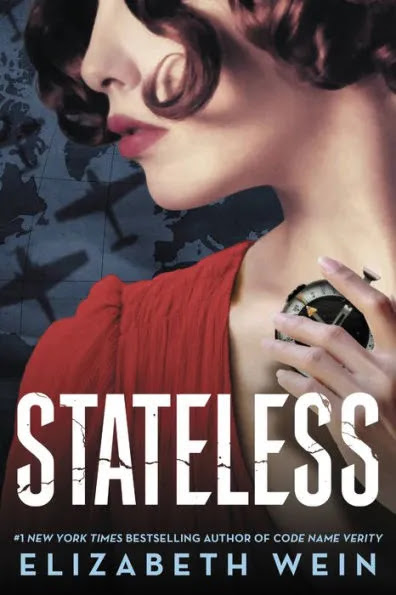
"Stateless"

New from Little, Brown Books for Young Readers: Stateless by Elizabeth Wein.

About the book, from the publisher:

From the beloved #1 bestselling author of Code Name Verity, this thrilling murder mystery set in 1937 Europe soars with intrigue, glamour, secrets, and betrayal.

When Stella North is chosen to represent Britain in Europe’s first air race for young people, she knows all too well how high the stakes are. As the only participating female pilot, it’ll be a constant challenge to prove she’s a worthy competitor. But promoting peace in Europe feels empty to Stella when civil war is raging in Spain and the Nazis are gaining power—and when, right from the start, someone resorts to cutthroat sabotage to get ahead of the competition.

The world is looking for inspiration in what’s meant to be a friendly sporting event. But each of the racers is hiding a turbulent and violent past, and any one of them might be capable of murder…including Stella herself.
Visit Elizabeth Wein's website.

The Page 69 Test: Black Dove, White Raven.

The Page 69 Test: The Pearl Thief.

Writers Read: Elizabeth Wein (January 2019).

The Page 99 Test: A Thousand Sisters.

--Marshal Zeringue

"In the Land of Tigers and Snakes"

New from Columbia University Press: In the Land of Tigers and Snakes: Living with Animals in Medieval Chinese Religions by Huaiyu Chen.

About the book, from the publisher:

Animals play crucial roles in Buddhist thought and practice. However, many symbolically or culturally significant animals found in India, where Buddhism originated, do not inhabit China, to which Buddhism spread in the medieval period. In order to adapt Buddhist ideas and imagery to the Chinese context, writers reinterpreted and modified the meanings different creatures possessed. Medieval sources tell stories of monks taming wild tigers, detail rituals for killing snakes, and even address the question of whether a parrot could achieve enlightenment.

Huaiyu Chen examines how Buddhist ideas about animals changed and were changed by medieval Chinese culture. He explores the entangled relations among animals, religions, the state, and local communities, considering both the multivalent meanings associated with animals and the daily experience of living with the natural world. Chen illustrates how Buddhism influenced Chinese knowledge and experience of animals as well as how Chinese state ideology, Daoism, and local cultic practices reshaped Buddhism. He shows how Buddhism, Confucianism, and Daoism developed doctrines, rituals, discourses, and practices to manage power relations between animals and humans.

Drawing on a wide range of sources, including traditional texts, stone inscriptions, manuscripts, and visual culture, this interdisciplinary book bridges history, religious studies, animal studies, and environmental studies. In examining how Buddhist depictions of the natural world and Chinese taxonomies of animals mutually enriched each other, In the Land of Tigers and Snakes offers a new perspective on how Buddhism took root in Chinese society.
--Marshal Zeringue

Friday, March 3, 2023

"Bitter Medicine"

New from Tachyon: Bitter Medicine by Mia Tsai.

About the book, from the publisher:

In this inspired contemporary fantasy, a Chinese immortal and a French elf navigate romance, family loyalty, and workplace demands. In her debut novel, Mia Tsai has created a paranormal adventure that is full of humor, passion, and depth.

As a descendant of the Chinese god of medicine, ignored middle child Elle was destined to be a doctor. Instead, she is underemployed as a mediocre magical calligrapher at the fairy temp agency, paranoid that her murderous younger brother will find her and their elder brother. Using her full abilities will expose Elle’s location. Nevertheless, she challenges herself by covertly outfitting Luc, her client and crush, with high-powered glyphs.

Half-elf Luc, the agency’s top security expert, has his own secret: he’s responsible for a curse laid on two children from an old assignment. To heal them, he’ll need to perform his job duties with unrelenting excellence and earn time off from his tyrannical boss.

When Elle saves Luc’s life on a mission, he brings her a gift and a request for stronger magic to ensure success on the next job—except the next job is hunting down Elle’s younger brother.

As Luc and Elle collaborate, their chemistry blooms. Happiness, for once, is an option for them both. But Elle is loyal to her family, and Luc is bound by his true name. To win freedom from duty, they must make unexpected sacrifices.
Visit Mia Tsai's website.

--Marshal Zeringue

"Revolutions in Cuba and Venezuela"

New from the University Press of Florida: Revolutions in Cuba and Venezuela: One Hope, Two Realities by Silvia Pedraza and Carlos A. Romero.

About the book, from the publisher:

Comparing two consequential movements that shed light on the nature of revolution

Revolutions in Cuba and Venezuela compares the sociopolitical processes behind two major revolutions—those of Cuba in 1959, when Fidel Castro came to power, and Venezuela in 1999, when Hugo Chávez won the presidential election. With special attention to the Cuba-Venezuela alliance, particularly in regards to foreign policy and the trade of doctors for oil, Silvia Pedraza and Carlos Romero show that the geopolitical theater where these events played out determined the dynamics and reach of the revolutions.

Updating and enriching the current understanding of the Cuban and Venezuelan revolutions, this study is unique in its focus on the massive exoduses they generated. Pedraza and Romero argue that this factor is crucial for comprehending a revolution’s capacity to succeed or fail. By externalizing dissent, refugees helped to consolidate the revolutions, but as the diasporas became significant political actors and the lifelines of each economy, they eventually served to undermine the social movements.

Using comparative historical analysis and data collected through fieldwork in Cuba and Venezuela, as well as from immigrant communities in the US, Pedraza and Romero discuss issues of politics, economics, migrations, authoritarianism, human rights, and democracy in two nations that hoped to make a better world through their revolutionary journeys.
--Marshal Zeringue