Tuesday, June 21, 2022

"Fellowship Point"

New from Scribner/Marysue Rucci Books: Fellowship Point: A Novel by Alice Elliott Dark.

About the book, from the publisher:

The masterful story of a lifelong friendship between two very different women with shared histories and buried secrets, tested in the twilight of their lives, set across the arc of the 20th century.

Celebrated children’s book author Agnes Lee is determined to secure her legacy—to complete what she knows will be the final volume of her pseudonymously written Franklin Square novels; and even more consuming, to permanently protect the peninsula of majestic coast in Maine known as Fellowship Point. To donate the land to a trust, Agnes must convince shareholders to dissolve a generations-old partnership. And one of those shareholders is her best friend, Polly.

Polly Wister has led a different kind of life than Agnes: that of a well-off married woman with children, defined by her devotion to her husband, and philosophy professor with an inflated sense of stature. She exalts in creating beauty and harmony in her home, in her friendships, and in her family. Polly soon finds her loyalties torn between the wishes of her best friend and the wishes of her three sons—but what is it that Polly wants herself?

Agnes’s designs are further muddied when an enterprising young book editor named Maud Silver sets out to convince Agnes to write her memoirs. Agnes’s resistance cannot prevent long-buried memories and secrets from coming to light with far-reaching repercussions for all.

Fellowship Point reads like a classic 19th-century novel in its beautifully woven, multilayered narrative, but it is entirely contemporary in the themes it explores; a deep and empathic interest in women’s lives, the class differences that divided us, the struggle to protect the natural world, and, above all, a reckoning with intimacy, history, and posterity. It is a masterwork from Alice Elliott Dark.
Visit Alice Elliott Dark's website.

--Marshal Zeringue

"Our Transgenic Future"

New from New York University Press: Our Transgenic Future: Spider Goats, Genetic Modification, and the Will to Change Nature by Lisa Jean Moore.

About the book, from the publisher:

How scientific advances in genetic modification will fundamentally change the natural world

The process of manipulating the genetic material of one animal to include the DNA of another creates a new transgenic organism. Several animals, notably goats, mice, sheep, and cattle are now genetically modified in this way. In Our Transgenic Future, Lisa Jean Moore wonders what such scientific advances portend. Will the natural world become so modified that it ceases to exist? After turning species into hybrids, can we ever get back to the original, or are they forever lost? Does genetic manipulation make better lives possible, and if so, for whom?

Moore centers the story on goats that have been engineered by the US military and civilian scientists using the DNA of spiders. The goat’s milk contains a spider-silk protein fiber; it can be spun into ultra-strong fabric that can be used to manufacture lightweight military body armor. Researchers also hope the transgenically produced spider silk will revolutionize medicine with biocompatible medical inserts such as prosthetics and bandages. Based on in-depth research with spiders in Florida and transgenic goats in Utah, Our Transgenic Future focuses on how these spidergoats came into existence, the researchers who maintain them, the funders who have made their lives possible, and how they fit into the larger science of transgenics and synthetics. This book is a fascinating story about the possibilities of science and the likely futures that may come.
The Page 69 Test: Sperm Counts.

--Marshal Zeringue

Monday, June 20, 2022

"Take No Names"

New from Ecco: Take No Names: A Novel by Daniel Nieh.

About the book, from the publisher:

A riveting thriller about a fugitive in search of a quick payday in Mexico City who finds himself in the crosshairs of a dangerous international scheme

Victor Li is a man without a past. To his new employer, Mark, he’s just an anonymous hired hand to help with the dirty work. Together, they break into storage units that contain the possessions of the recently deported, pocketing whatever is worth selling. Only Victor and his sister, Jules, know that he’s a wanted man.

Amid the backpacks and suitcases, Victor makes the find of a lifetime: a gem rare and valuable enough to change his fortunes in an instant. But selling it on the sly? Nearly impossible. Thankfully, its former owner, a woman named Song Fei, also left a book of cryptic notes—including the name of a gemstone dealer in Mexico City.

When Victor and Mark cross the southern border, they quickly realize that this gem is wrapped up in a much larger scheme than they imagined. In Mexico City, shadowy international interests are jockeying for power, and they may need someone with Victor’s talents—the same ones that got him in trouble in the first place.

On the heels of his knockout debut Beijing Payback, Daniel Nieh delivers Take No Names, a white-knuckled and whip-smart thriller that races to an electrifying finish.
Visit Daniel Nieh's website.

--Marshal Zeringue

"Misfire"

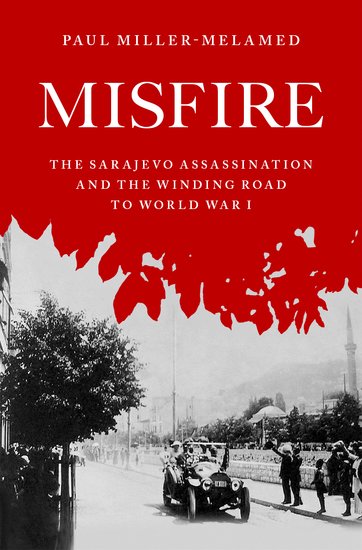
New from Oxford University Press: Misfire: The Sarajevo Assassination and the Winding Road to World War I by Paul Miller-Melamed.

About the book, from the publisher:

A new interpretation of the Sarajevo assassination and the origins of World War I that places focus on the Balkans and the prewar period.

The story has so often been told: Archduke Franz Ferdinand, heir to the throne of the Habsburg Empire, was shot dead on June 28, 1914, in the Bosnian capital of Sarajevo. Thirty days later, the Archduke's uncle, Emperor Franz Joseph, declared war on the Kingdom of Serbia, producing the chain reaction of European powers entering the First World War.

In Misfire, Paul Miller-Melamed narrates the history of the Sarajevo assassination and the origins of World War I from the perspective of the Balkans. Rather than focusing on the bang of assassin Gavrilo Princip's gun or reinforcing the mythology that has arisen around this act, Miller-Melamed embeds the incident in the longer-term conditions of the Balkans that gave rise to the political murder. He thus illuminates the centrality of the Bosnian Crisis and the Balkan Wars of the early twentieth century to European power politics, while explaining how Serbs, Bosnians, and Habsburg leaders negotiated their positions in an increasingly dangerous geopolitical environment. Despite the absence of evidence tying official Serbia to the assassination conspiracy, Miller-Melamed shows how it spiraled into a diplomatic crisis that European statesmen proved unable to resolve peacefully.

Contrasting the vast disproportionality between a single deadly act and an act of war that would leave ten million dead, Misfire contends that the real causes for the world war lie in "civilized" Europe rather than the endlessly discussed political murder.
--Marshal Zeringue

"The Precious Jules"

New from Blackstone: The Precious Jules by Shawn Nocher.

About the book, from the publisher:

A deeply felt family narrative that examines the fine line between selfishness and what passes for love.

After nearly two hundred years of housing retardants, as they were once known, the Beechwood Institute is closing the doors on its dark history, and the complicated task of reassigning residents has begun. Ella Jules, having arrived at Beechwood at the tender age of eight, must now rely on the state to decide her future. Ella’s aging parents have requested that she be returned to her childhood home, much to the distress of Ella’s siblings, but more so to Lynetta, her beloved caretaker who has been by her side for decades. The five adult Jules children, haunted by their early memories of their sister, and each dealing with the trauma of her banishment in their own flawed way, are converging on the family home, arriving from the far corners of the country—secrets in tow—to talk some sense into their aging parents and get to the root of this inexplicable change of heart.

The Precious Jules examines the thin line between selfishness and what passes for love. This family story asks what is best for one child in light of what is perceived as the greater good, and just what is the collective legacy of buried family secrets, shame, and helplessness. The Precious Jules is a deeply felt family narrative that will make you fall in love with these flawed and imperfect characters standing on the threshold of an awakening they never expected.
Follow Shawn Nocher on Twitter.

--Marshal Zeringue

"America’s Philosopher"

New from the University of Chicago Press: America’s Philosopher: John Locke in American Intellectual Life by Claire Rydell Arcenas.

About the book, from the publisher:

America’s Philosopher examines how John Locke has been interpreted, reinterpreted, and misinterpreted over three centuries of American history.

The influence of polymath philosopher John Locke (1632–1704) can still be found in a dizzying range of fields, as his writings touch on issues of identity, republicanism, and the nature of knowledge itself. Claire Rydell Arcenas’s new book tells the story of Americans’ longstanding yet ever-mutable obsession with this English thinker’s ideas, a saga whose most recent manifestations have found the so-called Father of Liberalism held up as a right-wing icon.

The first book to detail Locke’s trans-Atlantic influence from the eighteenth century until today, America’s Philosopher shows how and why interpretations of his ideas have captivated Americans in ways few other philosophers—from any nation—ever have. As Arcenas makes clear, each generation has essentially remade Locke in its own image, taking inspiration and transmuting his ideas to suit the needs of the particular historical moment. Drawing from a host of vernacular sources to illuminate Locke’s often contradictory impact on American daily and intellectual life from before the Revolutionary War to the present, Arcenas delivers a pathbreaking work in the history of ideas.
--Marshal Zeringue

Sunday, June 19, 2022

"The Hidden One"

New from Minotaur Books: The Hidden One (Kate Burkholder Series #14) by Linda Castillo.

About the book, from the publisher:

The discovery of an Amish bishop's remains leads chief of police Kate Burkholder to unearth a chilling secret in The Hidden One, a new thriller from bestselling author Linda Castillo.

Over a decade ago, beloved Amish bishop Ananias Stoltzfus disappeared without a trace. When skeletal remains showing evidence of foul play are unearthed, his disappearance becomes even more sinister.

The town’s elders arrive in Painters Mill to ask chief of police Kate Burkholder for help, but she quickly realizes she has a personal connection to the crime. The handsome Amish man who stands accused of the murder, Jonas Bowman, was Kate’s first love. Forced to confront a painful episode from her past, Kate travels to Pennsylvania’s Kishacoquillas Valley, where the Amish culture differs dramatically from the traditions she knows. Though Bishop Stoltzfus was highly respected, she soon hears about a dark side to this complex man. What was he hiding that resulted in his own brutal death?

Someone doesn’t want Kate asking questions. But even after being accosted and threatened in the dead of night, she refuses to back down. Is she too close to the case—and to Jonas—to see clearly? There’s a killer in the Valley who will stop at nothing to keep the past buried. Will they get to Kate before she can expose the truth? Or will the bishop’s secrets remain hidden forever?
Visit Linda Castillo's website.

The Page 69 Test: Sworn to Silence.

My Book, The Movie: Pray for Silence.

The Page 69 Test: Gone Missing.

--Marshal Zeringue

"Families We Keep"

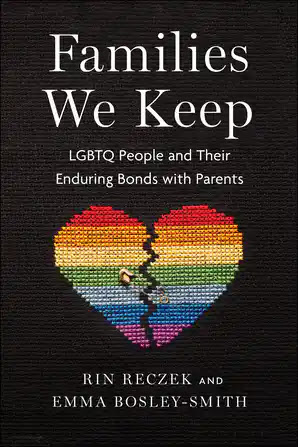
New from NYU Press: Families We Keep: LGBTQ People and Their Enduring Bonds with Parents by Rin Reczek and Emma Bosley-Smith.

About the book, from the publisher:

Why LGBTQ adults don’t end troubled ties with parents and why (perhaps) they should

Families We Keep is a surprising look at the life-long bonds between LGBTQ adults and their parents. Alongside the importance of “chosen families” in the queer community, Rin Reczek and Emma Bosley-Smith found that very few LGBTQ people choose to become estranged from their parents, even if those parent refuse to support their gender identity, sexuality, or both.

Drawing on interviews with over seventy-five LGBTQ people and their parents, Reczek and Bosley-Smith explore the powerful ties that bind families together, for better or worse. They show us why many feel obliged to maintain even troubled—and sometimes outright toxic—relationships with their parents. They argue that this relationship persists because what we think of as the “natural” and inevitable connection between parents and adult children is actually created and sustained by the sociocultural power of compulsory kinship. After revealing what holds even the most troubled intergenerational ties together, Families We Keep gives us permission to break free of those family bonds that are not in our best interests.

Reczek and Bosley-Smith challenge our deep-rooted conviction that family—and specifically, our relationships with our parents—should be maintained at any cost. Families We Keep shines a light on the shifting importance of family in America, and how LGBTQ people navigate its complexities as adults.
Visit Rin Reczek's website and Emma Bosley-Smith's website.

--Marshal Zeringue

"The Long Answer"

New from Riverhead Books: The Long Answer: A Novel by Anna Hogeland.

About the book, from the publisher:

A woman considers pregnancy, motherhood, and the nature of female relationships in this profound and provocative novel.

Twelve weeks pregnant for the first time, Anna speaks to her sister on the other side of the country and learns she has just miscarried her second child. As this loss strains their bond and complications with Anna’s own pregnancy emerge, her tenuous steps towards motherhood are shadowed and illuminated by the women she meets along the way, whose stories of the children they have had, or longed for, or lost, crowd in.

The Long Answer is a stunning novel of secrets kept, and secrets shared. Deeply empathetic and hugely absorbing, it unravels the intimate dynamics of female friendship, sisterhood, motherhood and grief, and the ways that women are bound together and pulled apart by their shared and contrasting experiences of pregnancy, abortion, miscarriage, and infertility.
Visit Anna Hogeland's website.

--Marshal Zeringue

Saturday, June 18, 2022

"Freedom Inside?"

New from Oxford University Press: Freedom Inside?: Yoga and Meditation in the Carceral State by Farah Godrej.

About the book, from the publisher:

An estimated forty million people in the United States regularly practice yoga, and as an industry it generates over nine billion dollars annually. A major reason for its popularity is its promise of mental and physical well-being: yoga and meditation are thought to be spiritual paths to self-improvement. Yoga is also widely practiced in prisons, another large business in the United States. Prisons in all fifty states offer yoga and meditation as a form of rehabilitation. But critics argue that such practices can also have disempowering effects, due to their emphasis on acceptance, non-judgment, and non-reaction. If the root of suffering is in the mind, as the philosophy behind yoga and meditation suggests, then injustice (including mass incarceration) may be reduced to a mental state requiring coping techniques rather than a more critical mindset. Others insist that yoga can heighten people's attention to structural violence, hierarchy, racism, and inequity. In fact, some of history's most radical activists, including M.K. Gandhi and Thich Nhat Hanh, traced their ethical and political commitments to their grounding in yogic or meditative traditions.

Yoga and meditation programs no doubt offer crucial respite for those who are incarcerated, but what sort of political effects do they have? Do they reinforce the neoliberal logic of mass incarceration which emphasizes individual choices, or can they assist marginalized people in navigating systemic injustice? Drawing on collaborations with incarcerated practitioners, interviews with volunteers and formerly incarcerated practitioners, and her own fieldwork with organizations offering yoga/meditation classes inside prisons, Farah Godrej examines both the promises and pitfalls of yoga and meditation. Freedom Inside? reveals the ways in which incarcerated persons have used yogic practices to resist the dehumanizing effects of prisons, and to heighten their awareness of institutional racism and mass incarceration among poor people and people of color. Godrej argues that while these practices could unwittingly exacerbate systemic forms of inequity and injustice, they also serve as resources for challenging such injustice, whether internally (via the realm of belief) or externally (through action). A combination of ethnography and political theory, Freedom Inside? reimagines the concept of "resistance" in a way that considers people's interior lives as a crucial arena for liberation.
Learn more about Farah Godrej's work.

--Marshal Zeringue